


Dutch Outdoor Genetics at 13°N: Do Frisian Dew and Durban Poison Work in Thailand?
The Dutch Outdoor badge marks varieties selected to finish outdoors in Northern Europe: cold nights, grey weeks, and rain arriving exactly when the flowers are at their most vulnerable. Two of them are in this catalogue — Frisian Dew and Durban Poison.
Thailand is not Northern Europe in any respect. So the question is a fair one, and the answer splits cleanly in two: one of the traits these plants were bred for is more valuable here than it is in Holland, and another is actively unhelpful.
What they are
| Frisian Dew | Durban Poison | |
|---|---|---|
| Type | Hybrid | Sativa |
| Lineage | Super Skunk × Purple Star | Durban × unknown indica |
| Flowering | About 8 weeks | About 8 weeks |
| Yield | XXL | XXL |
| THC | High | High |
| Environment | Outdoor and greenhouse only | Indoor and outdoor |
| Height outdoors | 3–4 m | 3–4 m, often over 3 m |
| Award | Prize winner | — |
| 1 seed | ฿510 | ฿510 |
| 10 seeds | ฿2,420 | ฿2,420 |
Both are XXL yielders that finish in eight weeks and cost the same. Both grow into something closer to a tree than a plant. The differences are in what they were selected against.
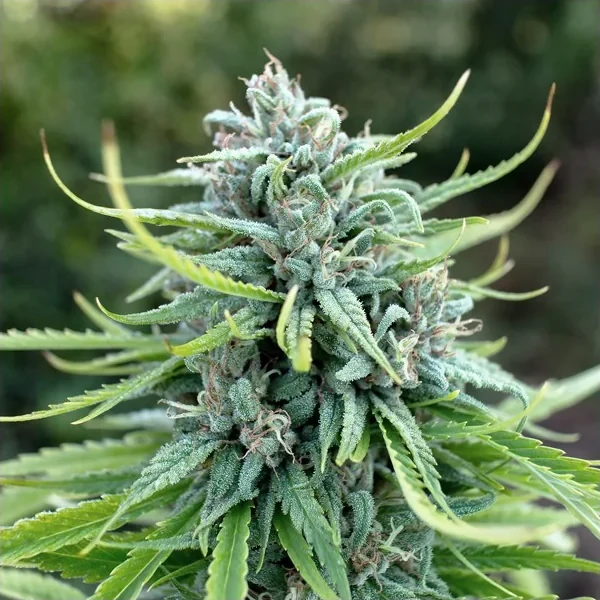
Frisian Dew was bred for the Dutch outdoor season, and its headline trait is mould resistance — it is one of the most rot-resistant varieties Dutch Passion sells, which is precisely what a Frisian autumn selects for. It also throws light purple flowers with an excellent flower-to-leaf ratio, which is not merely cosmetic; a low leaf ratio means less trapped moisture. Dutch Passion recommend it for outdoor and greenhouse growing only — it is not an indoor plant.
Durban Poison is a South African landrace out of Durban, inbred through the 1970s and then adapted through successive generations to Northern European conditions: wind, rain, short seasons. It went on to become a parent of the GSC line and, through it, of Sherbet and Gelato. Its flowers are unusually dense for a sativa.
The trait that transfers, and is worth more here
Mould resistance. Frisian Dew was selected under exactly the pressure that a Thai wet season applies, just at a different temperature. A variety that finishes clean through weeks of Dutch rain is a variety whose flower architecture and resin behaviour resist water sitting in the bud, and that property does not care whether the water arrived at 12 °C or at 28 °C.
If anything the trait is worth more at 13°N than at 53°N. A Dutch grower faces rain for the final three or four weeks of a season. A Thai wet-season grower faces it for the entire cycle, at temperatures that let fungal spores work several times faster. Everything in preventing mould and bud rot in tropical Thailand is a workaround for a problem that Frisian Dew partially solves at the genetic level.
That makes Frisian Dew one of the more interesting seeds in the catalogue for a Thai outdoor grower, and it is not an obvious conclusion from its description.
The trait that does not transfer at all
Photoperiod behaviour. This is the one that catches people, and it catches them badly enough to waste a season.
Both of these plants expect a European outdoor calendar: a long spring and summer of fifteen- and sixteen-hour days in which to build a three-metre frame, then shortening days in August that trigger flowering, then an October harvest. Frisian Dew’s entire architecture assumes it gets four or five months of vegetative growth before it is asked to flower.
Thailand does not provide that. Bangkok’s longest day is about thirteen hours and twelve minutes, and the annual swing is roughly an hour. From the plant’s point of view it is always late summer — the flowering signal is present more or less permanently. A Frisian Dew seed put into Thai soil in the expectation of a three-metre plant will begin flowering while it is knee-high and will produce a fraction of its XXL rating.
The XXL yield is not a property of the seed. It is a property of the seed plus five months of long days, and the second half of that is not for sale here. The mechanism is set out in autoflower vs feminised seeds in Southeast Asia.
There are two honest ways around it, both covered in mastering the 12/12 light cycle outdoors in tropical Thailand: run supplementary light through the vegetative period to hold the plant in veg until it has the frame you want, or accept a much smaller plant and plan for it. The first is more work than most balcony growers will do. The second is perfectly workable and produces a real harvest — it just is not the harvest the catalogue photograph shows.
Durban Poison has a second problem
Its buds are dense. The product description is candid about this: unusually dense for a sativa.
Density is the single worst flower property to own in a monsoon. Water enters the bud, the interior does not dry, and the rot starts in the core where you cannot see it until the whole cola is gone. That is the argument in sativa vs indica bud structure in the tropics, and Durban Poison is the case that shows why “sativa” on a label is not enough information — you want to know about structure, not classification.
Durban Poison is also listed as suitable for indoor growing, which Frisian Dew is not. Indoors, with a controlled light cycle and controlled humidity, both of the problems above disappear and you are left with an XXL, eight-week, prize-heritage sativa. That is where Durban Poison belongs in this country.
The verdict
Frisian Dew: yes, outdoors, with the day-length problem handled. Its mould resistance is a genuine asset in a wet-season grow and there is not much else in the catalogue that offers it. Expect a smaller plant than the marketing suggests unless you are running supplementary light. Do not attempt it indoors — the breeder says not to, and they are right.
Durban Poison: yes, indoors. Outdoors in the wet season the bud density works against you, and outdoors in the dry season you still have the photoperiod issue. Indoors it is straightforward, fast and generous.
Neither, if this is your first grow and you are on a balcony. Take an autoflower instead. The reasoning, and the alternatives, are in Critical Orange Punch vs Auto Critical Orange Punch.
Why we sell them anyway
Because the day-length problem is solvable, because indoor growing in Thailand is common and growing, and because Frisian Dew’s rot resistance is a real answer to the hardest problem this climate poses. What we would rather not do is let anyone buy a three-metre outdoor variety on the strength of a European photograph and find out in month two.
Write to us in Thai or English if you want a second opinion on whether one of these fits your space.