


Autoflower vs Feminised Seeds in Southeast Asia: Which Should You Choose?
If you are growing outdoors in Thailand, autoflowers are usually the better choice, and the reason is astronomical rather than horticultural: Bangkok sits at about 13.7° north, where the longest day of the year is only around thirteen hours. A photoperiod plant put outside here has almost no long-day season to grow in. If you are growing indoors with a light you control, that constraint disappears and feminised seeds give you the bigger plant and the bigger harvest.
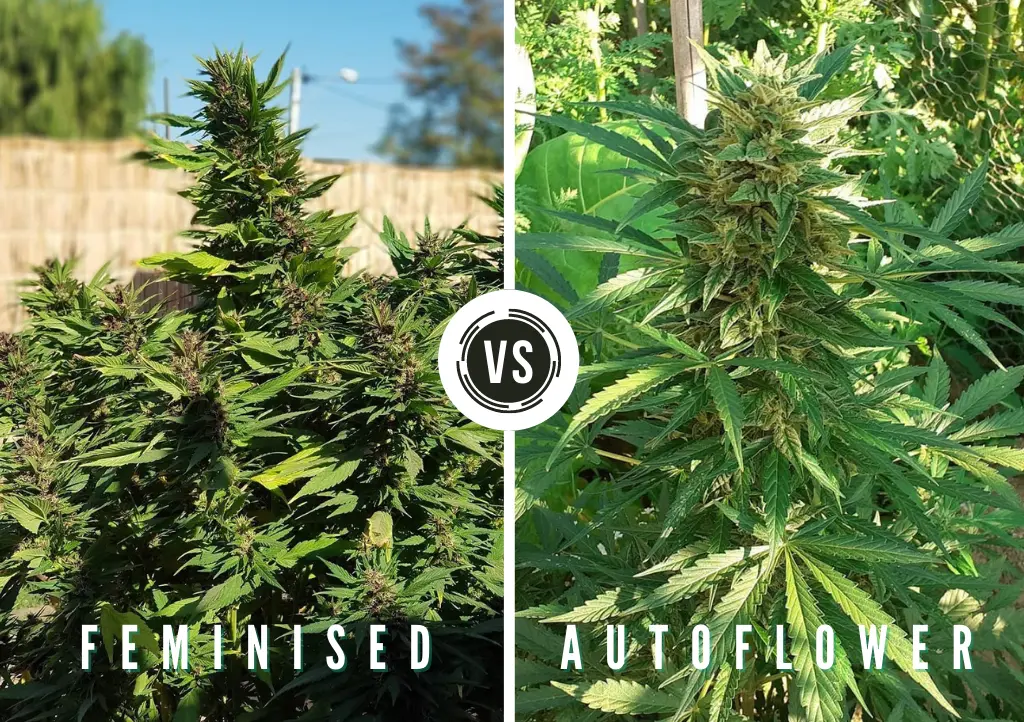
What the two words actually mean
Feminised seeds are ordinary photoperiod cannabis, bred so that essentially every seed produces a female plant. They stay in vegetative growth for as long as the daily light period is long enough — conventionally more than about fourteen hours — and begin flowering when it drops. Indoors, you trigger that yourself by switching the timer to twelve hours on and twelve hours off. You decide when the plant flowers, and therefore how big it is when it does.
Autoflowering seeds carry ruderalis ancestry, which flowers on age rather than on light. An autoflower begins making flowers roughly three to four weeks after germination no matter what the light is doing, and finishes on its own schedule. You give up control and get speed and simplicity in exchange.
Both are feminised in the sense that both produce female plants. “Feminised” as a category name is a historical accident of the industry; it means “photoperiod feminised”.
The part that is specific to Southeast Asia
At European latitudes, midsummer gives fifteen or sixteen hours of daylight, which is why photoperiod plants grown outdoors in Spain or the Netherlands vegetate all summer and flower in autumn.
Thailand does not have that season. Day length here varies across the year by less than two hours:
| Location | Longest day (June) | Shortest day (December) |
|---|---|---|
| Chiang Mai (18.8° N) | about 13 h 20 m | about 10 h 55 m |
| Bangkok (13.7° N) | about 13 h 05 m | about 11 h 10 m |
| Phuket (7.9° N) | about 12 h 35 m | about 11 h 40 m |
The practical consequence is that a photoperiod plant sown outdoors in Thailand sees a light period that is never far from the twelve-hour flowering signal. It will typically begin flowering within a few weeks of germination, at whatever size it has managed to reach — which is small. Growers new to the tropics often read this as a defective seed or a stressed plant. It is neither. It is the plant doing exactly what it evolved to do at a latitude it did not evolve for.
There are three ways around it, and they are the three routes worth understanding before you buy:
- Grow autoflowers outdoors. Day length becomes irrelevant. The plant runs its cycle and finishes.
- Grow feminised plants indoors, where you set the schedule.
- Supplement light outdoors — run a lamp for a few hours in the evening, or interrupt the night, to keep photoperiod plants vegetating. It works, and it is more equipment and more fuss than most home growers want.
Light schedules side by side
| Autoflower | Feminised (photoperiod) | |
|---|---|---|
| Indoor veg schedule | 18/6 or 20/4 throughout | 18/6 |
| Indoor flower schedule | Unchanged — 18/6 or 20/4 | Switch to 12/12 |
| Outdoors in Thailand | Works as-is, any month | Flowers early and small without supplementary light |
| Seed to harvest | About 10–15 weeks total | About 8–11 weeks of flower, plus however long you vegetate |
| Plant size | Small to medium, fixed | Whatever you grow it to |
| Recovery from mistakes | Poor — no time to recover | Good — extend veg and try again |
| Cloning | Not practical | Straightforward |
The 18/6 schedule is what Dutch Passion recommends for autoflowers, and it is also the more sensible choice in Thailand for a reason unrelated to the plant: six hours of darkness is six hours in which the lamp is not adding heat to a room that is already 30 °C outside. Running lights overnight and dark through the afternoon is a common and effective trick in Thai grow rooms.
Why autoflowers suit the tropical calendar
Speed is the obvious advantage, but the more valuable one is placement in the year. An autoflower takes ten to fifteen weeks from seed to harvest regardless of season, which means you can choose to finish it in the cool dry months rather than in the monsoon.
Sow in late October or November and an autoflower will ripen in January or February — Thailand’s driest, mildest window, with overnight humidity well below the wet-season figures that cause bud rot. A photoperiod plant does not give you that freedom outdoors, because the shortening days will pull it into flower on their own schedule.
The plants are also physically smaller, which in a wet climate is an advantage rather than a compromise: a one-metre plant in a fabric pot can be carried under a roof when a storm arrives. A three-metre Durban Poison cannot.
Shorter time in the ground also means less exposure to everything else — pests, mildew and the diseases that build up over a long season.
Where feminised seeds win
Yield per plant. A photoperiod plant vegetated for six weeks under your control will comfortably out-produce an autoflower of the same genetics, because you decided how large the frame was before flowering locked it in.
Training. Topping, low stress training, SCROG and supercropping all rely on the plant having time to recover. An autoflower that loses a week to stress loses that week permanently. A photoperiod plant simply stays in veg a week longer.
Cloning. Take a cutting from an autoflower and it flowers on the mother’s clock, at cutting size. Photoperiod plants can be kept as mothers indefinitely, which is how a grower who finds an exceptional phenotype keeps it.
Ceiling potency and terpene development. The most concentrated varieties in most catalogues are photoperiod, simply because breeders have had far longer to work with them.
What to buy
Autoflowers for the Thai outdoors or a small tent:
- Auto Critical Orange Punch — XXL yield, very high THC, around ten weeks from seed. The most productive autoflower in this catalogue and the sensible default.
- Auto Cinderella Jack — extremely high THC, ten to eleven weeks. The one to grow when potency is the point.
- Auto Ultimate — XXL, twelve to fifteen weeks. Longer, but the yield is exceptional for an autoflower.
- Auto Mimosa Punch — compact, very high THC, good for a balcony or a small tent.
- CBD Auto Charlotte’s Angel and CBD Auto Blackberry Kush — the low-THC, high-CBD autoflowers, covered in our guide to high-CBD cultivation.
Feminised photoperiod for an indoor room, or outdoors with supplementary light:
- Critical Orange Punch — XXL in eight weeks of flower.
- Durban Poison, Power Plant and Siam’s Smile — sativa structure that copes with heat and humidity, discussed further in our outdoor strain guide for Thailand.
- Meringue, Hifi 4G and Mokum’s Tulip — the extremely-high-THC end of the range, best grown in a controlled indoor space.
Browse the full autoflower seeds and feminised seeds categories, or the Outdoor Thailand selection for varieties chosen for this climate.
A straight recommendation
If this is your first grow, in Thailand, outdoors or on a balcony: buy autoflowers. Sow after the rains, harvest in the cool season, and learn the plant on a ten-week cycle where mistakes cost you weeks rather than months.
If you have an enclosed room with a light on a timer, air conditioning and a dehumidifier: buy feminised. The reason to build that room in the first place is control, and control is what photoperiod genetics repay.
Most experienced Thai growers end up running both — autoflowers outside through the dry season, photoperiod plants inside all year. There is no rule that says you must pick one.
If you are still deciding, choosing the right cannabis seeds covers the basics, and our FAQ answers the questions we get asked most about growing in Thailand’s climate.