


How to Beat Humidity: Preventing Mould and Bud Rot in Tropical Thailand
Bud rot is the most common way a Thai cannabis harvest is lost, and it is almost always lost in the last three weeks. The short answer is that you do not fight humidity by fighting the weather — you fight it by keeping air moving through the canopy, holding vapour pressure deficit inside a workable band, and choosing genetics with bud structure loose enough to dry out between rain showers.
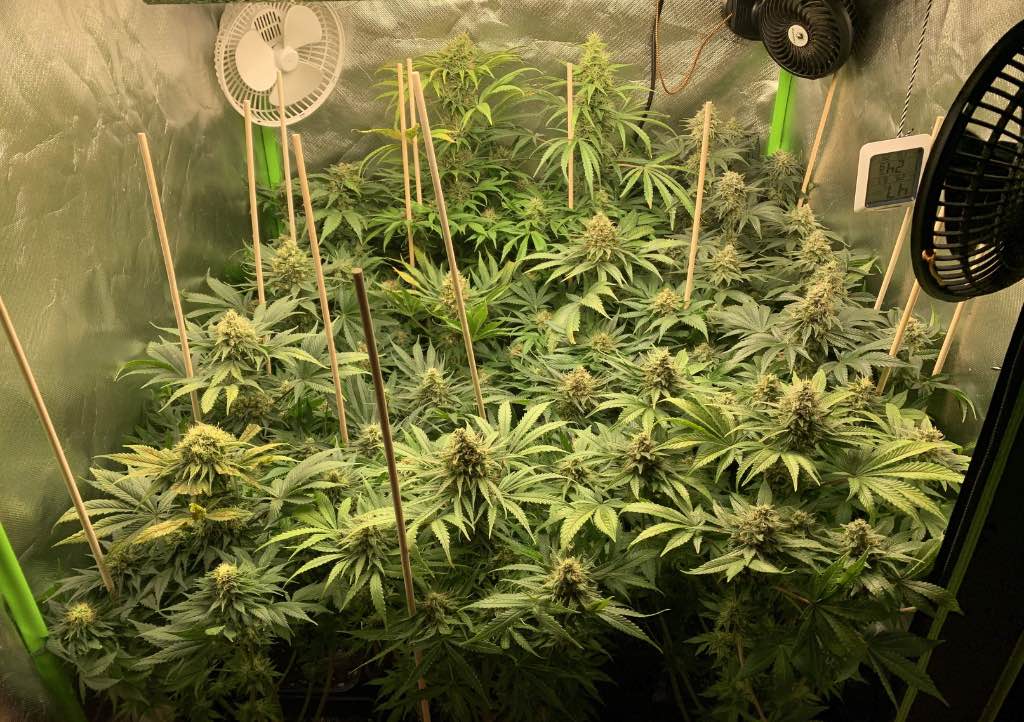
What bud rot actually is
Bud rot is Botrytis cinerea, a grey mould that lives in almost every soil and on almost every dead leaf on earth. Its spores are already in your grow space; there is nothing to keep out. What decides whether they germinate is free moisture and still air.
Botrytis needs a wet surface — condensation, rain, or transpired water that has nowhere to go — held for several hours at moderate temperatures. It is happiest between roughly 15 °C and 25 °C, which is why growers in cool wet climates lose crops to it. In Thailand the daytime temperature is usually too high for it to move fast, and that is exactly what lulls growers into ignoring it. The danger window here is the pre-dawn hours, when the temperature drops toward the dew point, relative humidity climbs past 90%, and moisture condenses inside dense flowers that have no airflow reaching them.
By the time you see it — a leaf inside a cola that pulls out grey and lifeless, or a bud that has gone brown and dusty at the core — the mycelium has already been through the stem. That flower is gone.
Thailand’s actual numbers
Bangkok’s relative humidity averages roughly 70–75% across the year, but the annual mean is not the number that matters. Through the southwest monsoon — broadly mid-May to mid-October — overnight humidity routinely sits above 85% and frequently reaches saturation. Chiang Mai and the north run drier in the cool season and just as wet in the rains; the south, Phuket and Krabi, stays humid nearly year-round with two monsoons rather than one.
Two consequences follow for growers:
- Outdoors, the wet season is the hard season. A plant finishing in September is finishing into the worst humidity of the year.
- Indoors, your dehumidifier is fighting the outdoor air. Every cubic metre your extraction fan pulls in arrives at ambient humidity, and in August that is 80% or more.
Hold VPD, not relative humidity
Relative humidity on its own tells you very little, because what a plant experiences depends on temperature as well. Vapour pressure deficit — VPD — is the difference between how much moisture the air is holding and how much it could hold at that temperature. It is measured in kilopascals and it is the number that predicts both transpiration and mould risk.
Low VPD means the air is close to saturated: the plant cannot transpire, water sits on leaf surfaces, and Botrytis gets what it needs. High VPD means the air is pulling moisture out faster than the roots can replace it, and the plant closes its stomata and stops growing.
| Stage | Target VPD | Practical example |
|---|---|---|
| Seedlings and clones | 0.4–0.8 kPa | 25 °C at 75–85% RH |
| Vegetative growth | 0.8–1.2 kPa | 27 °C at 65–75% RH |
| Early flower | 1.0–1.4 kPa | 27 °C at 60–68% RH |
| Late flower, final 3 weeks | 1.2–1.6 kPa | 26 °C at 50–58% RH |
The final row is the one that decides whether you harvest. Getting a Thai tent to 50–55% RH in the last three weeks of August is the whole problem, and it is worth building your room around.
One correction growers often miss: VPD should be calculated from leaf temperature, not air temperature. A leaf under a strong LED sits one to three degrees above ambient, which means your real VPD is higher than your controller thinks. An infrared thermometer pointed at a fan leaf costs very little and removes the guesswork.
Air circulation is the cheapest insurance you will buy
Botrytis cannot establish on a surface that is not wet. Moving air keeps surfaces dry, and it is far cheaper than removing water from a room.
- Intra-canopy circulation. You need air moving between the flowers, not across the top of them. Two oscillating fans at canopy height, aimed to cross each other rather than blast in one direction, will do more than one large fan. The leaves should be visibly trembling, not thrashing.
- Extraction. Size your inline fan to exchange the volume of the room roughly every one to three minutes. For a 1.2 × 1.2 × 2 m tent — about 2.9 m³ — a fan rated around 200–350 m³/h is sensible once you have allowed for the resistance of a carbon filter and ducting, which typically costs a third of the rated figure.
- Under-canopy air. A small fan low down, blowing across the pot surface, dries the humid layer that pools under a bushy plant. This is where rot in the lower buds usually starts.
- Night-time. Do not switch fans off with the lights. The pre-dawn hours are when you need them most.
Sizing a dehumidifier for 80% ambient
The honest rule is that a plant transpires nearly all of the water you give it. If your room drinks 10 litres a day, you need to remove about 10 litres a day, plus whatever comes in through the intake.
Two things trip people up in Thailand:
- Rating conditions. Dehumidifier capacities are quoted at a test condition. A unit sold as “20 litres per day” at 30 °C and 80% RH will pull far less at 26 °C and 55% — which is precisely the condition you are trying to hold in late flower. Buy on the manufacturer’s low-humidity figure if they publish one, and assume roughly half the headline number if they do not.
- Heat. A refrigerant dehumidifier dumps its heat into the room — usually a few hundred watts of it. In a Thai tent already fighting LED heat, that can push temperature up faster than it pulls humidity down, and you end up needing more cooling to make the dehumidifier useful.
For most home rooms the workable arrangement is a sealed or near-sealed space with air conditioning handling temperature and a dehumidifier handling the last of the moisture, rather than an open extraction setup drawing in monsoon air and trying to dry it.
Canopy management: give the air somewhere to go
- Defoliate deliberately. Removing fan leaves that sit directly over lower bud sites opens paths for air. Do it in stages — around the flip to 12/12 and again in week three of flower — rather than stripping a plant in one session.
- Lollipop the bottom. The lowest 20–30% of a plant produces small, loose, larfy flowers in the most humid, least ventilated part of the canopy. They are the first thing to rot and the least worth saving.
- Train for width, not height. Low stress training and a SCROG net spread the canopy into a single even layer where every flower gets the same airflow. Stacked colas shade and trap.
- Do not let colas touch. Where two flowers press together, the contact surface never dries.
Choosing genetics that can take it
Bud structure matters more than lineage labels. Dense, fist-sized indica colas hold water in the middle; airy, elongated sativa flowers shed it. Thailand is a sativa climate, and that is not an accident of history.
- Durban Poison — a pure landrace sativa from South Africa, bred over decades in heavy rain and wind. It has unusually dense flowers for a sativa but very open plant architecture, an eight-week flowering time that gets it finished early, and a high calyx-to-leaf ratio that leaves less vegetation to trap moisture.
- Power Plant — also South African in origin, tolerant of environmental swings, and fast. Long buds with short internodes, an XXL yield, and a reputation for shrugging off conditions that stall other plants.
- Siam’s Smile — a 1972 Thai jungle sativa crossed with Chocolate Thai. These are the genetics that evolved in this climate. Nine weeks, XXL yield, and the loose flower structure of a tropical landrace.
- Frisian Dew — Dutch Passion’s outdoor specialist, a Super Skunk × Purple Star hybrid selected specifically for outdoor resilience in a wet climate. Eight weeks and XXL.
- Skywalker Haze and Amsterdam Amnesia — sativa-dominant, tall, open, and airy. Longer flowering at nine to ten weeks, so plan the finish date against the rains.
Autoflowers deserve a mention of their own. Because they run on their own clock rather than the photoperiod, an autoflower planted in November can be harvested in the cool dry season entirely, avoiding the monsoon rather than surviving it. That is covered in more detail in our comparison of autoflower and feminised seeds for Southeast Asia.
What to avoid finishing outdoors in the rains: the dense, resin-loaded USA-genetics hybrids. Sugar Bomb Punch, Meringue and Mokum’s Tulip build the kind of solid flowers that are magnificent indoors under controlled conditions and a liability in an 85% overnight.
Outdoor and monsoon microclimates
- Get plants off the ground. Humidity is highest in the first half-metre of air. Pots on a rooftop, a raised bench or a balcony sit in moving air; pots on soil in a walled garden sit in a still, wet pocket.
- Build a rain shelter, not a greenhouse. A clear roof with open sides keeps rain off flowers while letting the breeze through. A closed polytunnel in Thailand traps heat and moisture and makes the problem worse.
- Shake the plants after rain. Physically knocking water off the colas within an hour of a downpour removes the free moisture Botrytis needs. It looks crude and it works.
- Watch the wall. A plant against a west-facing wall gets radiated heat all evening and no airflow. A plant in an open corner of a rooftop gets breeze from every direction.
Drying is where Thai harvests are lost twice
A crop that survived the field is still at risk. The classic drying target — 18–20 °C at 55–60% RH over ten to fourteen days — is not a condition that exists anywhere in Thailand without equipment. Drying in ambient 30 °C air at 80% RH will grow mould on your buds inside 48 hours; drying in front of a fan or under air conditioning set to dehumidify will dry them so fast the chlorophyll never breaks down and the flavour never arrives.
Use a small sealed room or a converted wardrobe with an air conditioner and a dehumidifier, hold the numbers, and check daily. There is more on this in our guide to harvesting and curing.
If you find rot
Cut it out immediately, and cut wide. Take the affected flower and several centimetres of stem either side, into a bag, and out of the room — do not carry an infected cola through the canopy shedding spores. Sterilise your scissors between cuts. Then look hard at what caused it, because Botrytis in one cola means the conditions for Botrytis exist everywhere in that room.
If a plant is heavily infected three weeks from harvest, taking an early harvest of clean material usually beats losing everything to save a fortnight of ripening.
The short version
Choose sativa-structured or fast-finishing genetics; hold late-flower VPD between 1.2 and 1.6 kPa; move air through the canopy day and night; open the plant up so the air can get in; and dry in a controlled space rather than in the weather. Do those five things and Thailand’s climate stops being a threat and starts being the advantage it should be — twelve hours of daylight, year-round warmth, and a growing season with no winter in it.
Growing conditions, seed choice and the paperwork that goes with a licensed grow are covered further in our FAQ and in cannabis seeds and the law in Thailand.