


High-CBD Strains in Thailand: A Complete Guide to Low-THC Cultivation
CBD-rich cannabis is a different crop from THC cannabis in almost every way that matters to a grower: different chemistry, different market, different regulatory treatment, and — in one important respect that catches people out — the same regulatory treatment. This guide covers what CBD genetics are, what the Thai thresholds actually are, and how to grow the varieties available here.
What a CBD-rich variety is
Cannabis produces cannabinoids from a shared precursor. A gene controls whether that precursor is converted mainly to THCA — which becomes THC — or mainly to CBDA, which becomes CBD. Plants carry two copies of that gene, and the combination determines the chemotype:
| Chemotype | Genetics | Result |
|---|---|---|
| THC-dominant | Two THCA-synthase copies | High THC, negligible CBD |
| Balanced, roughly 1:1 | One of each | Meaningful amounts of both |
| CBD-dominant | Two CBDA-synthase copies | High CBD, THC typically under 1% |
This is why a CBD-rich variety cannot be produced by growing a THC variety differently. It is a genetic property fixed at the seed, and it is why buying stable, tested CBD genetics matters more here than in any other part of the catalogue. A “CBD strain” from an unstable line will throw plants across all three columns of that table, and in a regulated environment that is not a quality problem — it is a compliance problem.
A 1:1 variety and a CBD-dominant variety are not interchangeable. A 1:1 chemotype still contains substantial THC and is still psychoactive, with the CBD moderating rather than removing the effect. A CBD-dominant variety, with THC held below 1%, produces the therapeutic profile without a meaningful high. Which one you want depends entirely on what you are growing for.
The Thai numbers that matter
Three thresholds, and they do different jobs. Getting them mixed up is the most common mistake we see.
- 1.0% THC by dry weight is the Thai definition of hemp — Cannabis sativa L. subsp. sativa with no more than 1% THC in its leaves and inflorescence. Above that figure, the plant is cannabis rather than hemp, with a different licensing regime.
- 0.2% THC by weight is the extract threshold. Extracts above 0.2% THC were never removed from Category 5 of the narcotics schedule and remain narcotics. CBD extract below 0.2% THC, from material cultivated in Thailand, is not.
- Zero relevance to the flower rules. This is the one that surprises people. The Notification on Controlled Herbs (Cannabis) B.E. 2568, in force since 26 June 2025, makes cannabis inflorescence a controlled herb dispensable only against a PT 33 prescription. It regulates the flower as a category. A low-THC flower is still a flower. Growing a CBD-dominant variety does not put you outside the controlled-herb framework, and anyone marketing it that way is selling you a misunderstanding.
There is a further point specific to hemp licensing: hemp seed must be sourced from a licensed seed producer, cultivation is restricted to the area named on the licence, and THC testing must be done at an accredited laboratory. If your intended route is a hemp licence rather than a cannabis one, confirm the seed-sourcing requirement with your licensing authority before you buy anything, from us or anyone else.
For the full regulatory picture with the instruments named and dated, see cannabis seeds and the law in Thailand and our regulation timeline.
The genetics available here
Dutch Passion’s CBD-rich range descends from one variety, which makes the family easy to understand.
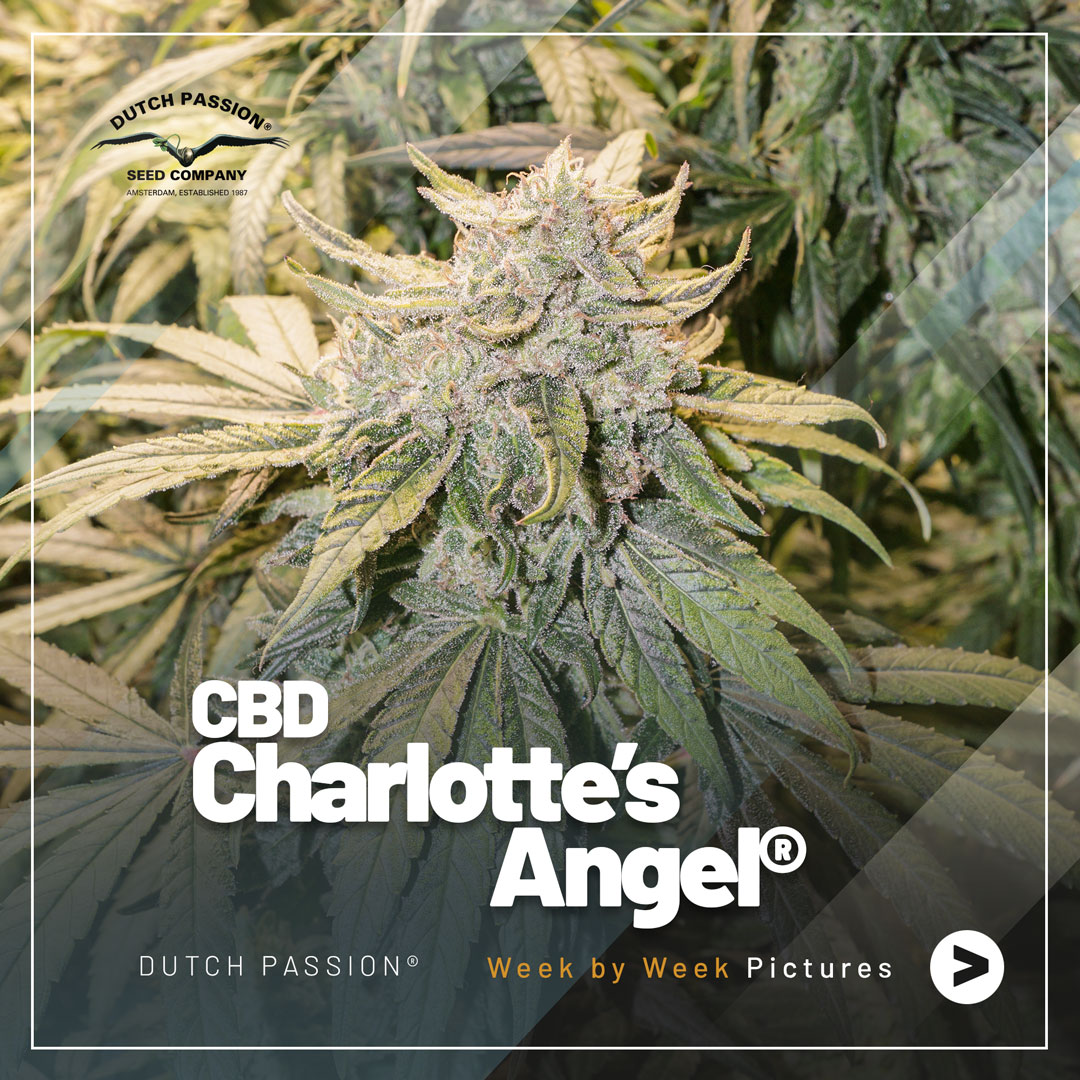
CBD Charlotte’s Angel
Sativa-dominant · CBD around 15% · THC consistently below 1% · about 11 weeks of flower · XL yield · Dutch Charlotte × Red Angel
CBD Charlotte’s Angel is the highest-CBD variety Dutch Passion breeds and the parent of the rest of the range. CBD content typically runs between 10% and 16%, averaging around 15%, with exceptional phenotypes reaching considerably higher. THC stays consistently below 1% — usually somewhere between 0 and 0.8%, varying with environment and cultivation technique.
That variability is worth dwelling on, because it is the practical reality of low-THC cultivation: the chemotype is fixed by genetics, but the exact figure is influenced by how you grow. If you are cultivating to a threshold, you test, and you test the material you actually harvested rather than assuming the catalogue figure.
It has won three awards in two years — first prize in the CBD category at the Highlife Cannabis Cup in 2018, third at Expogrow Irun in 2019, and second at the CBD Rich Cup in Spain the same year — which is worth mentioning mainly because CBD varieties have a reputation for tasting like nothing. This one does not: a herbal, spicy aroma with diesel, citrus and pine, and blueberry and earth in some phenotypes.
Tall and sativa-dominant, it suits both SCROG and SOG. Eleven weeks of flowering is the longest in this list, which in Thailand means planning the finish carefully against the rains.
CBD Auto Charlotte’s Angel
Sativa · CBD 10–15% · low THC · about 13 weeks seed to harvest · L yield · CBD Charlotte’s Angel × CBD Auto Compassion Lime
CBD Auto Charlotte’s Angel takes the same chemistry into an autoflowering plant. Thirteen weeks from seed to harvest, a compact frame, and — critically for Thailand — complete independence from day length, so the cycle can be placed in the cool dry season rather than in the monsoon. For a patient growing their own supply on a balcony, this is usually the right seed.
CBD Auto Blackberry Kush
Indica · CBD around 15% · low THC · about 13 weeks seed to harvest · XL yield · CBD Charlotte’s Angel × Auto Blackberry Kush
CBD Auto Blackberry Kush is the indica-leaning member of the family, with high CBD, a non-psychoactive effect and notably good bag appeal — dark, resinous flowers that do not look like a compromise. XL yields make it the most productive of the three autoflowers.
The one caution for Thai growers is structural: indica-dominant plants build denser flowers, and dense flowers hold moisture. Grow it in the dry season, or grow it under cover, and read preventing mould and bud rot in tropical Thailand first.
All three are listed together under CBD seeds.
Growing CBD-dominant plants in a tropical climate
Agronomically, a CBD-rich plant is grown exactly like any other cannabis plant. Four things are worth adjusting.
1. Harvest window matters more. CBD accumulates through flowering and so, more slowly, does THC. Harvesting late pushes both figures up. If you are growing to stay under a threshold, an earlier harvest is the safer harvest, and the difference in CBD is usually smaller than growers expect.
2. Stress raises THC. Environmental stress — heat spikes, drought, light burn, physical damage — tends to nudge cannabinoid ratios. It is not a large effect, but if you are cultivating close to 1% it is not a negligible one either. A stable, well-run room is a compliance tool.
3. The eleven-week flowering time is the constraint. CBD Charlotte’s Angel is the longest-flowering variety discussed on this site. Started outdoors in Thailand without supplementary light, it will begin flowering early and small — see autoflower vs feminised seeds in Southeast Asia for why day length does that here. Indoors, or as one of the autoflowers, the problem disappears.
4. Test rather than assume. A catalogue percentage is a range across many grows in many conditions. A laboratory result on your own harvest is a fact about your crop. If your licence, your buyer or your peace of mind depends on the number, buy the test.
Who this is for
- Patients who want the therapeutic profile without impairment, and who need a supply that does not interfere with work or driving.
- Growers new to cannabis who want to learn the plant on something with a gentler effect.
- Licensed operators supplying the CBD side of the market, for whom the chemotype stability and documented parentage of a bred line is a compliance asset as much as a quality one — the records an auditor expects are covered in our GACP documentation guide.
What we are not claiming
CBD is not a medicine we are qualified to prescribe, and nothing above is medical advice. The therapeutic literature on CBD is genuinely promising in some areas and genuinely thin in others, and a seed company is not the right source for that distinction — talk to a practitioner, particularly one authorised to write a PT 33 prescription, who can consider your own circumstances.
What we can tell you accurately is what these seeds are: stable CBD-dominant genetics, bred over years for the highest CBD content with THC held as low as possible, with the parentage and the measured ranges published. That is the part a seed company can stand behind.
Questions about ordering, delivery or documentation are answered in our FAQ, or write to us in Thai or English.