


Thailand Cannabis Regulation Update: Buying, Growing and Prescriptions
Thai cannabis regulation has changed materially three times since 2022, and almost every guide online describes one of the earlier positions as though it were current. This article is a dated timeline — what changed, when, and what it means for a patient, a resident grower and a commercial operator respectively.
For the standing statement of what the law requires, including the position on seeds specifically, this site maintains cannabis seeds and the law in Thailand. That page is the one we re-date when the rules move. This article is the history that explains how they got here.
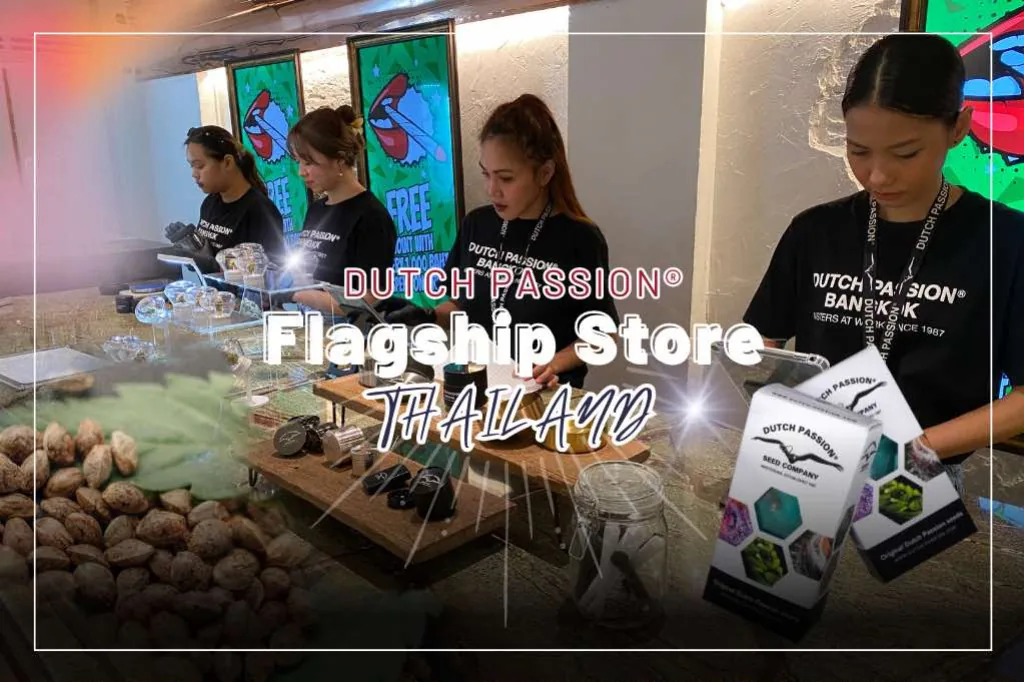
Photo: the Dutch Passion flagship store on Thaniya Road, Bangkok. Courtesy of Dutch Passion.
The one-paragraph summary
Cannabis is not a narcotic in Thailand — the plant was removed from the narcotics schedule in June 2022 and has not been put back. Since 26 June 2025 the flower has been a controlled herb, which means it may be dispensed only against a prescription. Cultivation has been a notifiable activity since 2022 and still is. Extracts above 0.2% THC by weight were never delisted and remain Category 5 narcotics. Seeds are not the controlled item under any of this. There is still no Cannabis and Hemp Act; everything operates through ministerial notifications and regulations.
The timeline
9 June 2022 — cannabis leaves the narcotics schedule
A Ministry of Public Health notification removed all parts of the cannabis and hemp plant from Category 5 of the narcotics list, with one carve-out: extracts containing more than 0.2% THC by weight remained narcotics, and still do. That carve-out is the single most misunderstood part of Thai cannabis law. The plant was decriminalised; concentrated THC was not.
Cultivation became a notifiable activity from the same date, registered through the Thai FDA’s system — the one most people know by the name of its app, Plook Ganja.
16 June 2022 — cannabis becomes a controlled herb
A week later, a second notification designated cannabis a controlled herb under the Protection and Promotion of Traditional Thai Medicine Wisdom Act B.E. 2542. This is where the rules most people can recite came from:
- Sale to anyone under 20 is prohibited, as is sale to pregnant or breastfeeding women.
- Smoking in public is treated as a public nuisance under the Public Health Act, with penalties of up to three months’ imprisonment and a fine of up to 25,000 baht.
Neither of these has been repealed. They are the rules that were in force throughout the period commonly described as “legal weed in Thailand”, and they were widely ignored.
2022–2025 — the gap
A comprehensive Cannabis and Hemp Act was drafted, debated and repeatedly not passed. In its absence the sector grew under ministerial notifications written for herbal medicine rather than for a retail industry. Dispensary numbers reached roughly 18,400 by 2024.
26 June 2025 — flower becomes prescription-only
The Notification on Controlled Herbs (Cannabis) B.E. 2568 took effect and closed the open-retail period. Under it:
- Cannabis inflorescence — the flower — may be dispensed only against a prescription written by an authorised practitioner: a doctor, dentist, pharmacist or Thai traditional medicine practitioner.
- The prescription is issued on the official PT 33 form, and is a physical document following a consultation.
- Dispensaries selling flower must operate under the supervision of a licensed practitioner.
- Flower that is sold or exported must come from a cultivation site certified under GACP — Good Agricultural and Collection Practices, certified by the Department of Thai Traditional and Alternative Medicine.
This is the change that reshaped the market. By February 2026, industry reporting put the number of dispensaries that had closed since the 2024 peak at around 7,300.
26 April 2026 — extract licensing narrows
A Ministerial Regulation on Category 5 narcotics covering cannabis and hemp extracts B.E. 2569 was published in the Royal Gazette in March 2026 and came into force thirty days later. It restricts who may be licensed to produce, import, export, sell or possess high-THC extracts — in practice, Thai juristic persons that are not “foreign” under the Foreign Business Act B.E. 2542, government agencies, and the Thai Red Cross Society. Foreign-owned businesses are outside that pathway.
30 April 2026 — flower licensing tightens
Ministerial Regulation No. 2 B.E. 2569 set cumulative conditions on anyone licensed to sell flower, including the requirement that trained staff be present throughout opening hours.
What this means if you are a patient
You need a prescription on the PT 33 form from an authorised practitioner, obtained after a consultation, and you buy from a licensed dispensary operating under practitioner supervision. Prescriptions are written for a defined supply period rather than open-endedly.
You must be 20 or over. Cannabis is not dispensed to people who are pregnant or breastfeeding.
Consuming in public remains a public-nuisance offence regardless of whether you hold a prescription.
What this means if you live in Thailand and want to grow
Cultivation is notifiable, and the notification is the point at which the state records who is growing, where, and how much. Growing for your own medical use and growing to supply anyone else are two different undertakings with two different sets of paperwork — anything you intend to sell as flower has to come from a GACP-certified site, which is an inspection regime rather than a form.
Registration presumes a legal residence in Thailand. If you are not a Thai resident, do not assume any of this is open to you, and be aware that the consequences of getting it wrong fall harder on foreign nationals. Check your own position before you plant anything.
Seeds themselves are not the controlled item under the 2025 notification, and are not narcotics. Dutch Passion Thailand sells seeds, delivered inside Thailand only. What Thai law has never done is set out a separate, explicit position on seeds the way some jurisdictions do — so anyone telling you the question is fully settled is overstating it. The law page on this site sets out what is settled and what is not, at length.
What this means if you are a commercial operator
Three practical consequences:
- GACP is now a commercial precondition, not a badge. Flower for sale or export has to come from a certified site. Certification follows an audit, runs for one to three years, and carries annual surveillance. The seed provenance records it expects are covered in our GACP documentation guide.
- Extracts and flower are separate regulatory worlds. A licence to sell flower is not a licence to produce high-THC extract, and the extract pathway is closed to foreign-owned entities.
- Ownership structure matters more than it used to. The April 2026 extract regulation draws a line by nationality of the legal person. Anyone building a business plan across both flower and extracts should take advice on structure early rather than late.
What has not changed
- Cannabis is not back on the narcotics schedule. Recurrent reporting that Thailand has “recriminalised cannabis” describes a proposal, not an enacted instrument.
- There is still no Cannabis and Hemp Act. Until one passes, the ministerial-notification regime is the law, which is precisely why the position has moved three times in four years and can move again.
- The 20+ age limit and the public-consumption prohibition have been in force continuously since June 2022.
Sources and standing
The instruments referred to above are the Ministry of Public Health narcotics delisting of June 2022, the controlled-herb notifications of June 2022 and June 2025 (B.E. 2568, in force 26 June 2025), and the two ministerial regulations of April 2026. All are published in the Royal Gazette. The Thai FDA administers cultivation registration; the Department of Thai Traditional and Alternative Medicine administers GACP certification and the controlled-herb framework.
This is a plain summary of published regulation written by a seed retailer. It is not legal advice, and it cannot take account of your circumstances — your residence status, what you intend to grow, or what your licence says. Where a decision turns on it, confirm the current position with the Thai FDA or DTAM, or take advice, rather than relying on any commercial site including this one.