


How to Master the 12/12 Light Cycle for Outdoor Growing in Tropical Thailand
Growers who arrive in Thailand from Europe or North America almost all make the same discovery in their first season: the plant starts flowering at knee height, six weeks after it germinated, and finishes at a fraction of the size it should have reached. Nothing went wrong. Thailand sits close enough to the equator that the sky is running something very near a 12/12 flowering schedule all year round, and a photoperiod plant reads that exactly as it is written.
The fix is not more sun, more feed or a bigger pot. It is a few watts of light in the middle of the night.
Thailand’s daylight, in actual numbers
Day length is a function of latitude. The further you are from the equator, the more the year swings; the closer you are, the flatter it gets. Thailand spans roughly 6°N at Betong to 20°N at Chiang Rai, which is a very flat part of that curve.
| Location | Latitude | Longest day (late June) | Shortest day (late December) | Annual swing |
|---|---|---|---|---|
| Chiang Mai | 18.8°N | ~13 h 15 m | ~11 h 00 m | ~2 h 15 m |
| Bangkok | 13.8°N | ~12 h 55 m | ~11 h 20 m | ~1 h 35 m |
| Phuket | 7.9°N | ~12 h 35 m | ~11 h 40 m | ~55 m |
Compare that with Amsterdam at 52°N, where midsummer runs to about 16 h 45 m and midwinter to about 7 h 45 m — a nine-hour swing. Dutch outdoor genetics were selected inside that swing. They expect a long vegetative summer and a decisive shortening in August that tells them to flower.
Thailand gives them neither. Bangkok’s shortest night of the entire year is about eleven hours, and eleven hours of darkness is already at or beyond the flowering threshold for most photoperiod varieties.
What actually triggers flowering is the night, not the day
Cannabis is a short-day plant, which is a botanically misleading name: what it measures is the length of the uninterrupted dark period. The mechanism is phytochrome, a pigment that exists in two interconvertible forms. Red light converts it to the active form; through a long dark period it reverts, and when enough of it has reverted the plant reads that as a long night and commits to flowering.
Two consequences follow, and both are the whole basis of this article:
- The threshold is a night length, so it is the night you manage. Most modern photoperiod hybrids initiate flowering somewhere around a 10.5 to 12 hour night. Tropical landrace sativas, which evolved here, tend to need longer nights and to respond more slowly — which is precisely why Thai sativas have a reputation for taking forever.
- A dark period that is interrupted is not a long night. Phytochrome resets with a small amount of red light. The plant is not counting total darkness; it is measuring the longest unbroken stretch. Break the night in the middle and you have given the plant two short nights instead of one long one.
That second point is worth more than any equipment purchase, because it means the light you need is not growing light. The sun does the growing. You only need enough light to move a pigment.
What happens if you do nothing
A seedling has a juvenile phase — usually three to five weeks — during which it will not flower whatever the photoperiod does. After that, in Thailand, it flowers. So the vegetative stage you get outdoors is not a season, it is a fixed few weeks of youth, and the plant’s final size is whatever it managed to reach in that time plus its flowering stretch.
In practice that means:
- Plants that finish at 60–100 cm rather than two or three metres.
- Yields well below what the variety is capable of, on genetics you paid for precisely because of that capability.
- A harvest date set by when you germinated, not by when the weather is good — which in Thailand is how crops end up finishing into the monsoon. That is the failure mode covered in preventing mould and bud rot in tropical Thailand.
- Occasional confusing behaviour, because ~11 hours is marginal. A plant sitting right on its threshold may start to flower, stall, and partially revert, which is stressful and can produce intersex flowers.
Option A: night interruption — the cheap answer
This is the technique ornamental growers have used commercially for decades to hold chrysanthemums vegetative, and it transfers directly.
Run a low-intensity lamp for one to two hours centred on solar midnight. The plant experiences two nights of five hours each instead of one night of eleven, neither of which is long enough to trigger flowering, and it stays in vegetative growth.
Solar midnight in Thailand is not midnight on the clock. Indochina Time is UTC+7, which is the meridian at 105°E, and Bangkok sits at about 100.5°E — so the sun is about eighteen minutes behind the clock and solar midnight in Bangkok falls around 00:18. Chiang Mai, further west at about 99°E, is closer to 00:24. A timer set for 23:30 to 01:30 covers either comfortably.
What you need:
- Intensity: far less than you think. Ornamental horticulture works at a few lux. Cannabis literature is thinner and growers report more reliable results at higher levels, so aim for something in the region of 5–10 µmol/m²/s at the canopy — in practice a 20–40 W LED panel or a couple of household LED bulbs over two or three square metres.
- Spectrum: red matters most; a warm-white LED contains plenty. The old incandescent night-break lamps worked because of their red and far-red output, and warm white is a reasonable stand-in.
- Coverage: the response is in the leaves, so the light must reach the whole plant, not just the top. A lamp above the canopy plus reasonable spacing between plants is enough.
- A timer. Consistency matters more than intensity. A night you forget is a night the plant counts.
The running cost is trivial. A 30 W lamp for two hours a night is 0.06 kWh a day, about 1.8 kWh a month — at typical Thai domestic rates, on the order of 8–10 baht per month.
Option B: day extension
The alternative is to add light at either end of the day until the total reaches 18 hours — turn the lamp on before dawn, or leave it on after dusk. It works, and it is conceptually simpler.
It is also five or six hours of lamp time instead of two, and, if you are trying to make that light do useful photosynthetic work rather than just hold the switch, it needs real intensity and real wattage. Day extension is the right choice if you are running a greenhouse and want genuine supplemental light anyway. For a patio or a rooftop, night interruption does the same job for a fraction of the electricity.
A hybrid many growers settle on: extend the evening by two hours at low intensity, which is easier to live with than a lamp coming on at half past eleven at night in a residential building.
Option C: accept 12/12 and grow accordingly
There is a legitimate strategy that does not fight the latitude at all: treat Thailand’s sky as a permanent flowering room, run many small plants rather than a few big ones, and take a fast harvest. This is the sea-of-green approach and it suits balconies. Expect one main cola per plant, a short cycle, and a yield per plant that is small but arrives quickly.
If you go this way, pick varieties with a short flowering time so the plant’s stretch does most of the work — Durban Poison, Power Plant and Critical Orange Punch all finish in around eight weeks.
Option D: sidestep the question entirely
Autoflowering varieties do not measure the night at all — they flower on age. In Thailand that removes the whole problem: no lamps, no timers, no season, and about ten to twelve weeks from seed to harvest. The trade-off is a smaller plant and no ability to hold it back while it grows.
The full comparison is in autoflower vs feminised seeds in Southeast Asia.
Flipping: when to switch the lamp off
Once the plant is the size you want, stop the night break and let the sky flower it. The plant will show pistils in one to two weeks.
Two things to plan around:
- Stretch. Most varieties roughly double in height after the flip; a sativa can do more. If you want a two-metre finished plant, flip at about one metre. Sativa-dominant plants like Skywalker Haze and Amsterdam Amnesia stretch hard and should be flipped earlier than feels right.
- The finish date. Count backwards. A nine-week variety flipped on 1 August is finishing in early October, in the tail of the southwest monsoon. Flipped on 1 November it finishes in early January, in the cool dry season, which is the best harvest window Thailand has.
| Flip date | 8-week variety finishes | 9–10-week variety finishes | Verdict |
|---|---|---|---|
| June | Mid-August | Late August | Worst case — peak monsoon |
| August | Early October | Mid-October | Risky, tail of the rains |
| November | Early January | Mid-January | Cool, dry, ideal |
| January | Early March | Mid-March | Dry but hot; watch heat stress |
The practical Thai calendar is therefore: hold the plant vegetative through the wet months with the night break, flip in late October or November, and harvest into the dry season.
The reverse problem: unwanted light
Everything above works because a small amount of light at night has a large effect. That cuts both ways. A streetlamp, a neighbour’s security light, a porch light left on, or the glow through a thin curtain can all be enough to stop a plant flowering when you want it to, or to make it flower erratically and throw intersex flowers.
When you flip, walk out at midnight and look. If you can see the plant clearly, so can the plant. Shade cloth, a repositioned pot, or a screen on one side usually solves it.
What to grow this way
Extending veg is worth most on varieties that can use the size:
- Siam’s Smile — a 1972 Thai jungle sativa crossed with Chocolate Thai, nine weeks, XXL yield. These genetics come from this climate and reward a long veg with a very large plant.
- Power Plant — South African, eight weeks, XXL, and famously tolerant of conditions that stall other plants.
- Durban Poison — eight weeks, XXL, open architecture that copes with humidity, and early enough to beat the rains.
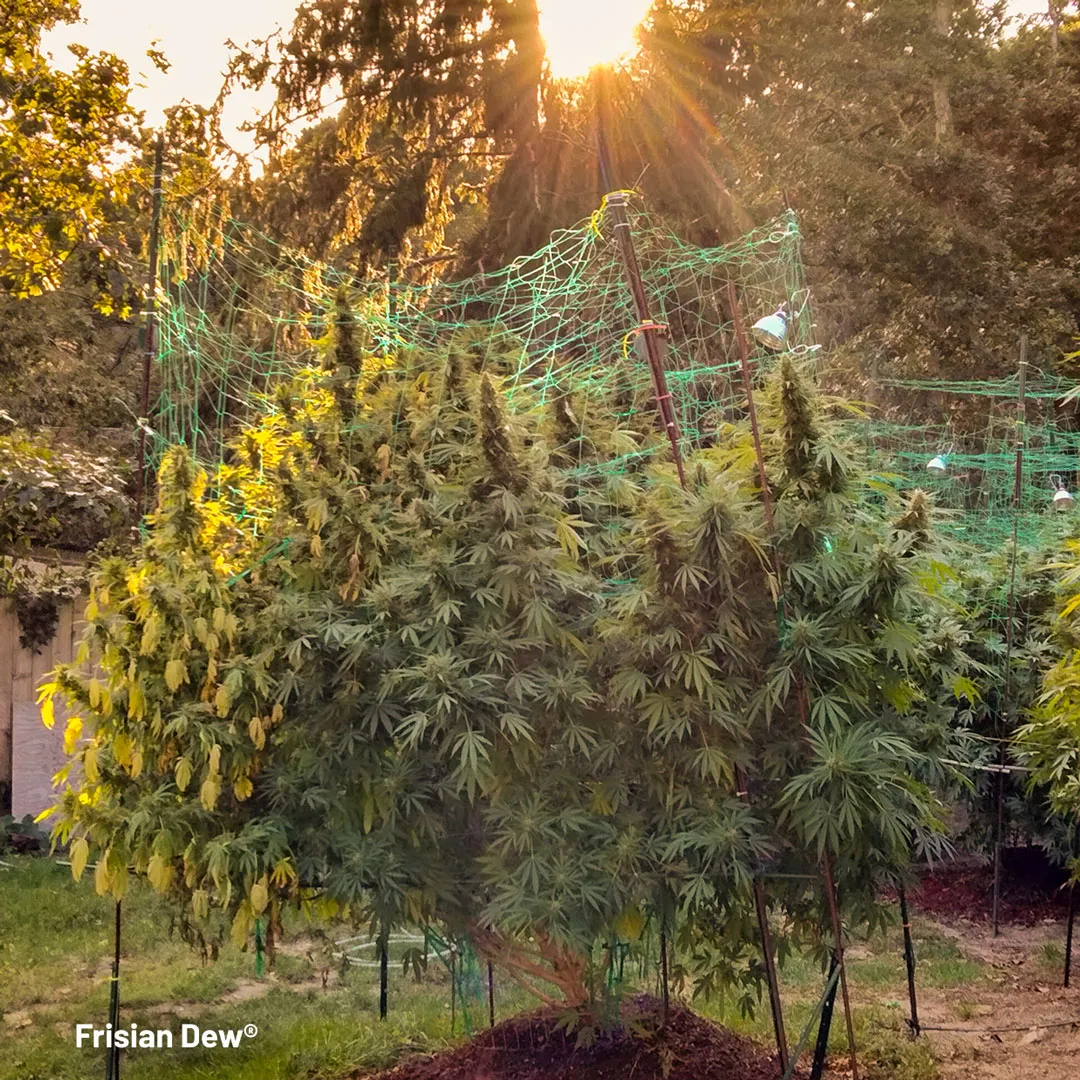
- Frisian Dew — Dutch Passion’s outdoor specialist, selected for wet-climate resilience, eight weeks and XXL.
- Amsterdam Amnesia and Skywalker Haze — nine to ten weeks, tall and airy, best flipped early and finished in the dry season.
The short version
Thailand’s night is long enough to flower a photoperiod plant every single day of the year, so outdoor vegetative growth is something you have to create rather than something the season provides. A 20–40 W lamp on a timer from 23:30 to 01:30 does it for under ten baht a month. Hold the plant vegetative through the wet season, flip in November, and harvest in the dry — and the latitude that was costing you two thirds of your yield becomes the twelve-month growing season it should have been all along.
Cultivation rules, registration and what Thai law requires of a home grower are set out in cannabis seeds and the law in Thailand.