


Five Heat-Resistant Dutch Passion Strains for Outdoor Growing in Southeast Asia
Thailand’s growing calendar has two hard seasons, not one. Everybody warns you about the monsoon; far fewer people warn you about March to May, when Bangkok sits at 35–38 °C in the shade, the UV index reaches eleven or twelve, and a black plastic pot on a concrete rooftop can push its root zone past 40 °C by mid-afternoon.
The rain problem is a structural problem, solved by choosing open, airy flowers — that argument is made in sativa vs indica bud structure in the tropics. The heat problem is a physiological one, and it is solved by lineage and by what you do below the soil line.
What heat actually does to a cannabis plant
Cannabis photosynthesises best somewhere around 25–30 °C. Push past roughly 30–32 °C and net photosynthesis starts falling; past about 35 °C the plant is losing ground.
The mechanism is water, not temperature directly. As air warms, its capacity to hold moisture rises steeply, and the vapour pressure deficit — the pull the air exerts on the leaf — rises with it. Beyond a point the roots cannot resupply water fast enough, so the plant closes its stomata to protect itself. Closed stomata means no carbon dioxide entering, which means photosynthesis stops, and it also means the leaf loses its evaporative cooling and gets hotter still.
You see it as four distinct symptoms:
- Tacoing. Leaf edges curl upward into a canoe shape, reducing the surface exposed to the sun. This is the plant’s own thermostat and it is a warning, not a disease.
- Foxtailing. Under sustained heat and intense light in late flower, the plant starts stacking new calyx growth on top of existing bud sites, producing spire-like towers instead of a solid cola. It is not harmful in itself, but it produces a lighter, looser flower that ripens unevenly — some of it ready while newly-formed tips are not.
- Terpene loss on the living plant. Monoterpenes are volatile at ordinary temperatures. A flower baking at 38 °C is quietly losing the aroma you grew it for, before you ever cut it.
- Stalling. The plant simply stops. Days pass with no growth, and in flower those are days of bulking you do not get back.
And then there is the part nobody photographs: root zone temperature. Cannabis roots start suffering above roughly 27–28 °C and dying above the mid-thirties, and hot wet media is where Pythium and Fusarium thrive. Most plants people describe as “heat-stressed” were actually cooked from below.
What makes a variety cope
Three lineages, historically, have produced plants that hold up in extreme heat, and they arrive at it from opposite directions:
- Equatorial sativas — Thai, African, Brazilian. Narrow leaflets that shed heat efficiently through a thinner boundary layer, steep leaf angles that reduce midday interception, and an evolutionary history of exactly this light intensity.
- Desert and high-altitude Afghan lines — the Mazar-i-Sharif and Hindu Kush families. Thick waxy cuticles, heavy resin production as a physical UV shield, and tolerance of enormous day-to-night temperature swings.
- Californian and Mediterranean selections — bred outdoors in hot, high-light, dry summers.
The fourth factor is not genetic at all: a short flowering time. A variety that finishes in eight weeks can be planned around the heat entirely.
The five
1. Skywalker Haze — the sun-loving sativa
Original Skywalker × Amsterdam Amnesia. Sativa, 9 weeks, XXL yield, very high THC.
Haze genetics were assembled from equatorial sativas — Thai, Mexican, Colombian and South Indian — and it shows in how this plant handles a tropical afternoon. Narrow leaflets, an open frame that lets heat out of the canopy rather than trapping it, and the sativa habit of continuing to work at temperatures where broad-leaved plants have shut down.
It grows tall and stretches hard, so flip it earlier than instinct suggests. Nine weeks is fast for a Haze-influenced plant and it is what makes this variety practical rather than merely impressive.
Grow it if: you have height available and full sun, and you want the classic soaring Haze effect from a plant that will not sulk in April.
2. Auto Ultimate — Mazar genetics, on its own clock
The Ultimate × Auto Mazar. Autoflowering hybrid, 12–15 weeks from seed, XXL yield, very high THC.
The Mazar side of this cross traces to Mazar-i-Sharif in northern Afghanistan, a landrace from a region that runs above 40 °C in summer. That ancestry brings the desert toolkit — waxy leaf surfaces, heavy resin, and a robustness that shows up as a plant simply not reacting to conditions that visibly upset its neighbours.
Being autoflowering matters as much as the genetics. It ignores photoperiod entirely, which in Southeast Asia removes the whole vegetative problem, and it lets you plant so the flowering weeks fall wherever you want them in the calendar. Start it in November and the bulk of flowering happens in the cool season.
It is rated outdoor and greenhouse, and XXL is an unusual yield rating for an autoflower.
Grow it if: you want the largest possible harvest from a plant that needs no light management. It is the closest thing in the Thai catalogue to true Mazar heat tolerance.
3. Amsterdam Amnesia — height, air and resilience
Sativa, 9–10 weeks, XXL yield, very high THC.
Amnesia is a Haze-lineage sativa and behaves like one: tall, long-limbed, wide internode spacing, and comfortable in strong light. The open architecture is doing double duty in Southeast Asia — it lets hot air escape the canopy in the dry season and lets humid air move through it in the wet.
Nine to ten weeks is the longest finish on this list, so it wants planning. Flipped in late October it comes down in January, which is the best harvest window Thailand has.
Grow it if: you have space, sun and the patience to plan the season backwards from the finish date.
4. Tropical Tangie — Californian outdoor breeding
Elite Tangie selection (Tangie × Tangie). Sativa, 9 weeks, XL yield, very high THC.
Tangie descends from Californian Orange lines, selected and grown outdoors in a climate of long, hot, high-light summers. It is a sativa-dominant plant with open citrus colas, and the terpene profile is limonene-forward — worth noting because limonene is one of the more volatile monoterpenes and is exactly what you lose to a hot late flower. The variety produces enough of it that some survives.
Grow it if: you want an aromatic, citrus-heavy flower and you can give it a bright position and a finish that avoids the worst heat.
5. Banana Blaze — the Afghan outlier
Old School Banana Indica. Indica, 8 weeks, XL yield, high THC.
This one breaks the pattern deliberately. Banana Blaze sits in the Afghani Kush family, and Afghan landraces are among the most heat- and drought-tolerant cannabis on earth — they simply solved the problem with wax and resin rather than with leaf shape. Eight weeks is the shortest flowering time on this list, and short flowering is itself a heat strategy: it lets you get in and out of the field before conditions turn.
The honest caveat is the one from the structure article. Indica-type flowers are dense, and dense flowers in an August monsoon are a rot risk. Banana Blaze is a dry-season and greenhouse recommendation, not a plant to leave standing in the rains.
Grow it if: you are growing in the cool dry season, or under cover, and you want a compact, fast, heat-indifferent plant.
Two varieties people ask about
Growers who know the wider Dutch Passion range often ask specifically about Mazar and Desfrán for hot climates, and both reputations are deserved — Mazar for its Afghan heat tolerance, Desfrán for its Brazilian sativa ancestry. Neither is currently stocked in the Thailand catalogue. The closest available equivalents are Auto Ultimate for the Mazar side, which carries it directly, and Siam’s Smile or Power Plant for equatorial sativa vigour. If you want either specifically, ask us — availability changes.
Honourable mentions
Three varieties that would be on this list if they were not already the subject of high-THC strains for outdoor growing in Thailand:
- Durban Poison — South African landrace, eight weeks, XXL. The all-round outdoor benchmark for this region.
- Power Plant — South African, eight weeks, XXL, famously tolerant of conditions that stall other plants.
- Siam’s Smile — Thai jungle sativa ancestry, nine weeks, XXL. Genetics that evolved in this exact climate.
And for growers who want low-THC material, CBD Charlotte’s Angel is a sativa-structured CBD variety that handles sun well — see high-CBD strains in Thailand.
Genetics is half of it; the root zone is the other half
The best heat-tolerant variety in the world will still fail in a black pot on a concrete roof. Fix the growing environment and every plant on this list performs better.
| Problem | Fix |
|---|---|
| Black plastic pots absorbing radiation | Light-coloured or fabric pots; wrap existing pots in white cloth or reflective sheet |
| Pot standing on hot concrete | Raise on a pallet, bench or bricks so air passes underneath |
| Small pot volume heating fast | Go larger — thermal mass buys hours; 30–50 L outdoors |
| Bare medium surface | Mulch with straw or coco chip; 3–5 cm drops surface temperature substantially |
| Midday water stress | Water early morning and again at dusk, never at midday onto hot media |
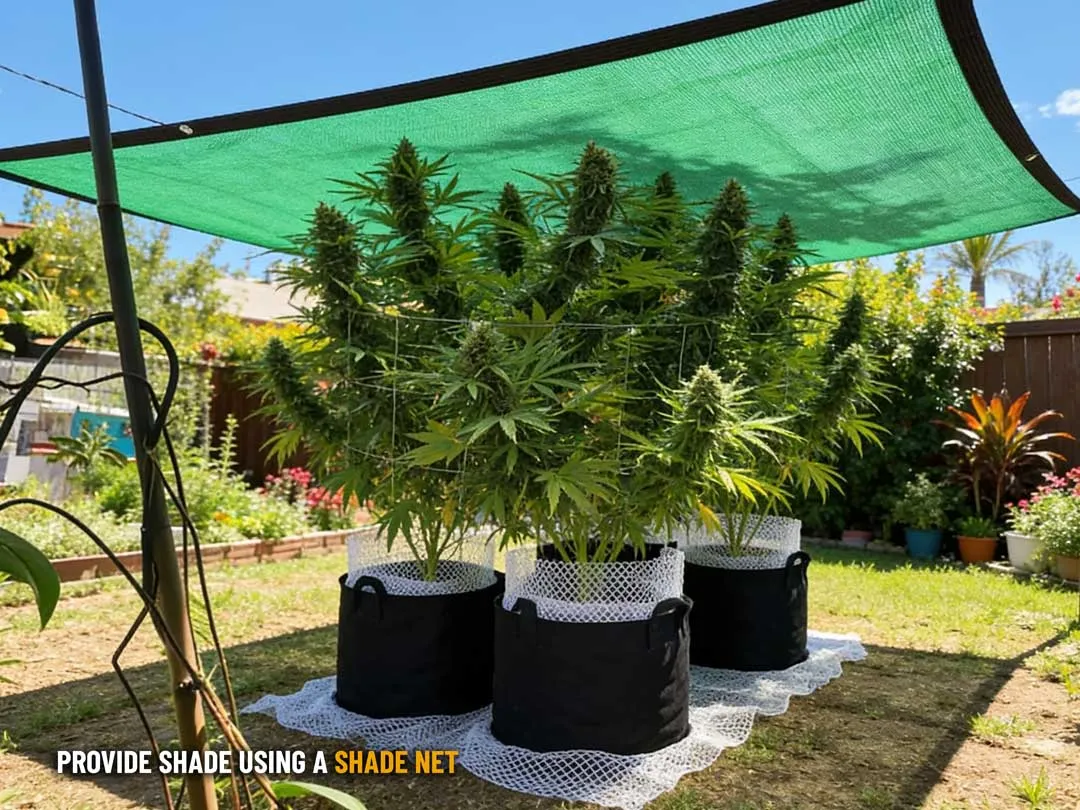
| Peak radiation, 11:00–15:00 | 30–40% shade cloth over the hottest hours costs very little yield and prevents stalling |
| Still hot air pooling in the canopy | Space plants; even outdoors, a fan on a rooftop earns its keep |
Two more that are worth the effort: silicon supplementation strengthens cell walls and measurably improves heat and drought tolerance, and it is cheap; and do not defoliate heavily in a heatwave, because those leaves are shading the ones below and shading the medium.
Planning the Southeast Asian year
| Period | Conditions | What to do |
|---|---|---|
| Nov–Feb | Cool, dry, 11 h days | The prime window. Anything on this list, including the dense varieties. |
| Mar–May | Very hot, dry, extreme UV | Heat lineages only; shade cloth, root-zone management, avoid finishing in late April |
| Jun–Oct | Wet, humid, monsoon | Airy structure and short flowering only; Banana Blaze under cover if at all |
Everything about the light schedule that makes photoperiod plants workable outdoors here is in mastering the 12/12 light cycle for outdoor growing in Thailand.
The short version
Heat tolerance comes from one of three ancestries — equatorial sativa, desert Afghan, or Californian outdoor — or from finishing fast enough not to meet the heat at all. Skywalker Haze, Auto Ultimate, Amsterdam Amnesia, Tropical Tangie and Banana Blaze cover all four routes between them.
Then fix the root zone, because a plant with perfect genetics and 42 °C soil is still a plant that stopped growing in March.