


Sativa vs Indica in the Tropics: Why Airy Bud Structure Wins Outdoors
Ask what separates sativa from indica and you will usually be told something about the effect — uplifting versus sedating, head versus body. That distinction is the least reliable thing the two words carry. Chemical analysis of commercial varieties has repeatedly found little correlation between the label on the packet and the cannabinoid and terpene profile inside it, and almost everything sold today is a hybrid of hybrids anyway.
What the two words do still describe, reliably, is shape. And in a tropical climate, shape is the single characteristic that decides whether a flower reaches harvest or turns grey in the last three weeks.
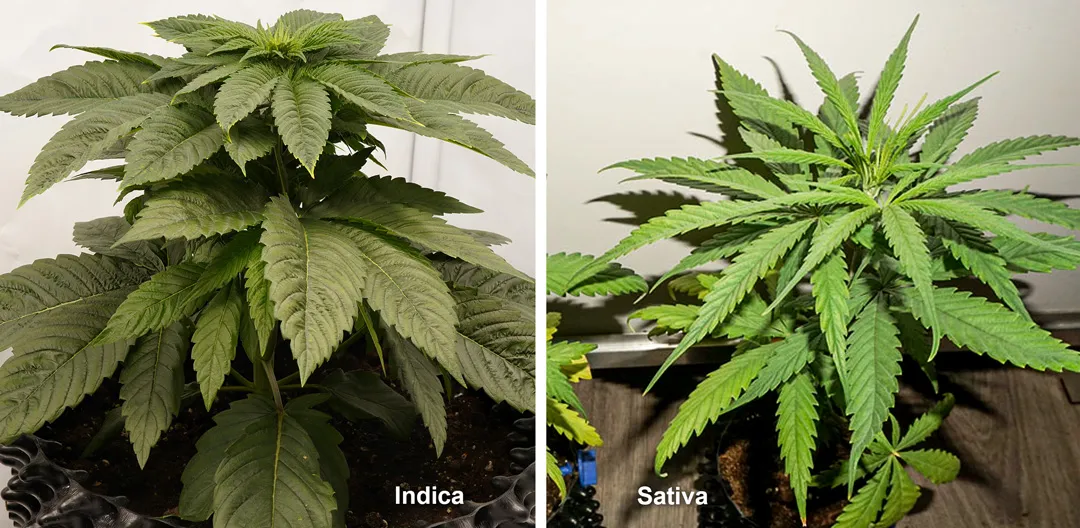
Two plants, two climates, two solutions
Both morphologies are adaptations, and knowing what they are adaptations to explains everything that follows.
The broad-leaved, compact type — what the trade calls indica — comes from the mountains of Afghanistan, Pakistan and northern India. That is a short, dry, cool growing season at altitude. A plant there has limited time, intense ultraviolet exposure, and very little airborne moisture to worry about. The response was a short bushy plant with broad leaves, a short flowering period, and flowers built as tight clusters packed with resin. Density costs nothing when the air is dry, and it protects the seeds it is carrying from cold and UV.
The narrow-leaved, elongated type — sativa — comes from equatorial regions: Thailand, southern India, Colombia, Nigeria, Malawi. Long season, no cold, and humidity approaching saturation for months at a time. Density there is lethal. What evolved instead is a tall open plant, long internodes, narrow leaflets, and flowers strung out along the stem rather than balled up on it.
Thailand’s own landraces are the second kind, and they are that way because everything else died.
The physics of a dense bud in humid air
This is the part worth understanding properly, because it explains why the effect is so much larger than it looks.
A cannabis flower is a cluster of calyxes on a central stem. How tightly those calyxes are packed determines the flower’s porosity — the proportion of it that is air, and the ease with which air can move through it.
- A dense cola is close to a solid object. Air moves over it, not through it. When it rains, water penetrates the outer layer and then has nowhere to go; the surface dries within an hour and the interior stays at or near saturation for the rest of the day. The core of a large dense flower can hold above 90% relative humidity long after the plant looks dry.
- An airy cola is closer to a bottlebrush. Air moves between the calyxes, so the interior dries at nearly the same rate as the surface.
Botrytis cinerea — bud rot — needs a wet surface held for several hours. It does not need much else; the spores are already present everywhere. So the whole question is how many hours a day the inside of your flower is wet, and that is decided almost entirely by porosity.
The rest of the structural picture matters for the same reason:
- Calyx-to-leaf ratio. Sativa flowers generally carry fewer, smaller sugar leaves. Leaf tissue inside a bud is thin, wet, slow to dry, and the first thing to die and go mouldy. Less of it is straightforwardly better in the tropics — and it means less trimming and a faster dry, as covered in drying and curing cannabis in high humidity.
- Internode spacing. Long internodes hold flowers apart. Where two colas press together, the contact surface never dries at all, and that is where rot appears first on tightly-branched plants.
- Overall architecture. A tall open plant is one that the breeze passes through. A compact bushy plant is a wind-break with a still, humid interior.
Narrow leaves are a heat adaptation too
Bud structure gets the attention, but leaf shape matters in Thai heat.
A leaf sheds heat by convection, and how well it does that depends on the thickness of the still boundary layer of air clinging to its surface. That layer is thinner over a narrow leaflet than over a broad one, so narrow leaves run closer to air temperature and broad leaves run hotter. On a 38 °C April afternoon in Isaan, a few degrees of leaf temperature is the difference between a plant that keeps its stomata open and photosynthesises and a plant that closes down and stalls.
Narrow-leaved plants also tend to hold their leaves at steeper angles, which reduces the intercepted radiation at midday when the sun is close to vertical — and at 13°N, near-vertical is what midday means.
The honest complication: sativas take longer
If bud structure were the only consideration, the recommendation would be simple: grow the most sativa-leaning plant you can find. It is not that simple, because the same equatorial ancestry that produced the open architecture also produced a long flowering period. Pure tropical landraces can run twelve to sixteen weeks in flower, and some barely stop.
In Thailand that is a real cost. Every extra week in flower is another week of monsoon exposure, another week of caterpillar pressure, and another week during which the thing that could go wrong has a chance to. A ten-week sativa is not automatically safer than an eight-week hybrid, because the hybrid was finished and hanging in the drying room while the sativa was still standing in the rain.
So the target for tropical outdoor growing is not maximum sativa. It is sativa structure with a compressed flowering time — the trait combination that African sativas in particular offer, and which Dutch breeding programmes spent decades stabilising.
| Trait | Ideal for Thai outdoor | Why |
|---|---|---|
| Flower density | Low to moderate | Interior dries between showers |
| Calyx-to-leaf ratio | High | Less wet vegetation inside the bud |
| Internode spacing | Long | Colas do not touch |
| Leaf shape | Narrow | Runs cooler in direct sun |
| Flowering time | 8–9 weeks | Shorter exposure beats better structure |
| Height | Tall, but plan for stretch | Air moves through, but 3 m is hard to manage |
Reading a seed listing for structure
Marketing copy will tell you about flavour and effect. What you want is four things, and all four are on the product pages of this site:
- Type — sativa, indica or hybrid. A starting point, not an answer.
- Harvest weeks — the hard number. Eight weeks is a different plant from eleven weeks in a monsoon.
- Lineage — where it actually comes from. “Original South African Power Plant” tells you more about how it will behave outdoors here than any effect description.
- The photographs. Look at the flowers. You can see porosity in a picture. A cola you cannot see daylight through is a cola that will not dry through either.
What the catalogue looks like through this lens
Built for the structure and finished quickly:
- Durban Poison — a South African landrace sativa, eight weeks, XXL. Unusually resinous flowers for a sativa but with very open plant architecture and a high calyx-to-leaf ratio. The benchmark for outdoor Thailand.
- Power Plant — also South African in origin, eight weeks, XXL, sativa, and unusually tolerant of environmental swings.
- Siam’s Smile — 1972 Thai jungle sativa crossed with Chocolate Thai, nine weeks, XXL. Tropical landrace architecture with a modern finishing time.
- Frisian Dew — a hybrid rather than a sativa, and included because it was selected specifically for outdoor resilience in a wet climate. Eight weeks, XXL. Proof that the structural argument beats the label.
Sativa structure, longer finish — worth it if you time the season:
- Skywalker Haze — nine weeks, XXL, tall and airy.
- Amsterdam Amnesia — nine to ten weeks, XXL, classic elongated Amnesia flowers.
- Tropical Tangie — nine weeks, XL, a Tangie selection with open citrus colas.
- Orange Bud — eight to nine weeks, XL, a genuinely old Dutch sativa selection.
Flip these earlier than feels right and count the finish date backwards from the rains — the calendar arithmetic is in mastering the 12/12 light cycle for outdoor growing in Thailand.
Dense hybrids — magnificent, and not for a monsoon field:
Sugar Bomb Punch, Meringue, Mokum’s Tulip and Hifi 4G build the solid, resin-loaded flowers modern USA genetics are known for. Under a controlled indoor environment they are among the best things you can grow. Left outside in an 85% overnight in September, that same density is a liability.
Which is to say: indica is not the problem, rain is
Nothing above is an argument that dense varieties are bad. Put them in an air-conditioned room where you control the humidity and density is an advantage — more flower per unit of canopy, faster to trim, easier to handle. The Afghan morphology is a superb solution to a dry environment, and an indoor grow room in Bangkok is a dry environment.
The rule is therefore about the pairing, not the plant:
- Outdoors or open greenhouse, wet season → airy structure, short flowering, high calyx-to-leaf ratio. Browse sativa seeds and outdoor varieties.
- Outdoors, cool dry season (November–February) → almost anything, if you finish before the heat of April.
- Sealed indoor room with AC and dehumidification → density is a feature. Indica seeds are on the table.
- Small space, any season → an autoflower’s ten-week cycle sidesteps the whole calendar. See autoflower vs feminised seeds in Southeast Asia.
The short version
Treat sativa and indica as descriptions of architecture and ignore them as descriptions of effect. In tropical outdoor conditions the trait that matters is porosity: can air get into the flower and dry its interior between rain showers. Airy flowers, long internodes, few sugar leaves and narrow leaflets are the tropical toolkit, and they exist because equatorial cannabis has been solving this exact problem for far longer than any of us have.
Then temper it with the calendar. The best outdoor variety for Thailand is the one with open structure that is also finished and hanging up before the worst of the weather arrives.
Practical humidity management for the plants you do grow is in preventing mould and bud rot in tropical Thailand.