


Pest Control in Tropical Climates: Beating Spider Mites, Thrips and Caterpillars Organically
Temperate growers get a free reset every year. Frost kills the overwintering population, and each spring the pressure starts from close to zero. Thailand does not do that. Nothing dies back, generations overlap continuously, and a spider mite that takes three weeks to complete a life cycle in a Dutch greenhouse completes it in five to seven days at 30 °C.
The practical consequence is that reactive spraying loses. What works here is a programme: know which pests are actually plausible in your particular setup, look for them before you can see damage, and keep a standing biological presence rather than a bottle you reach for in an emergency.
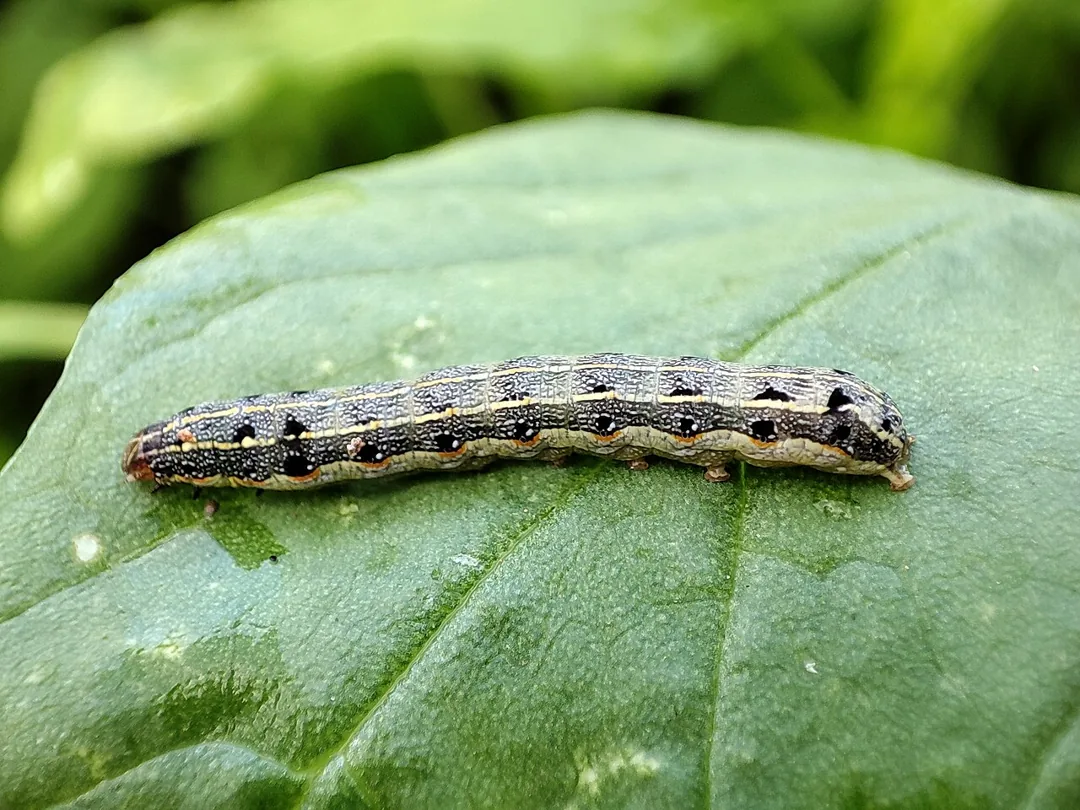
Photo: Wee Hong, CC BY-SA 4.0, via Wikimedia Commons.
This article assumes you have already met the basics — common pests and diseases in cannabis cultivation covers identification. What follows is what changes when the thermometer never drops and the air never dries.
The first thing to get right: indoors and outdoors have opposite problems
Growers waste a lot of money treating the wrong thing, because the advice they read was written for a climate where the same pests dominate in both environments. In Thailand they split cleanly.
| Environment | Dominant threats | Why |
|---|---|---|
| Air-conditioned indoor room | Spider mites, thrips, fungus gnats, root aphids | AC dries the air to 50–60% RH, which is close to ideal for two-spotted spider mite. You have built them a resort. |
| Outdoor and open greenhouse | Caterpillars, grasshoppers, whitefly, mealybug, snails | Monsoon humidity suppresses mites but is perfect for moths, and there is no season in which they stop. |
Spider mites are an indoor problem in Thailand. They hate humidity above roughly 60% and they collapse in it. If you are growing on a rooftop in August and you have webbing, look again — it is probably a caterpillar.
Caterpillars are the outdoor problem, and they are the one that costs whole harvests.
Caterpillars: the threat that actually loses Thai crops
The species that matter here are the tropical noctuid moths — Spodoptera litura, the tobacco cutworm, and Helicoverpa armigera, the cotton bollworm. Both are endemic across Thai agriculture, both are strong fliers, and both lay on cannabis readily.
The damage is not the eaten leaf. It is what happens next. A caterpillar bores into a developing cola, tunnels through it, and packs the tunnel with frass. That tunnel is a wet, dark, damaged cavity in the middle of a flower during monsoon season, which is exactly the condition Botrytis needs. Most bud rot in a Thai outdoor grow starts as a caterpillar. The two problems in preventing mould and bud rot in tropical Thailand and this one are the same problem.
Signs to look for, in the order they appear:
- A single yellowed or wilted leaf in the middle of an otherwise healthy cola — its stem has been chewed through.
- Small dark grains of frass caught in the flower or on the leaf below.
- A pinhole entry point, often at the junction of a bud and its stem.
- Grey or brown rot spreading outward from the middle of the bud.
By stage four you are cutting. Inspect at stage one.
The organic answer is Bacillus thuringiensis var. kurstaki. Bt is a soil bacterium whose crystal protein is toxic specifically to lepidopteran larvae and harmless to almost everything else — people, pets, bees, predatory insects. It is sold across Thailand to vegetable growers under the plain name บีที and it is inexpensive.
How to use it properly, because most failures are application failures:
- Spray preventatively from early flower, weekly, not when you find damage. Bt has to be eaten. A caterpillar already inside a bud is not eating the surface you sprayed.
- Spray at dusk. The crystal protein is degraded by ultraviolet light and has a short residual life in Thai sun — treat it as roughly a two to three day protection window in the wet season, shorter in strong sun.
- Cover the whole plant, including leaf undersides where eggs are laid.
- Reapply after rain. It washes off.
- Stop applying two weeks before harvest, not because it is unsafe but because you do not want any residue, wet or dry, sitting in a finished flower.
Alongside Bt, a moth trap or two — pheromone or light — will tell you when a flight is happening, which is when spraying is worth most. And walking the plants at dusk with a torch and picking caterpillars off by hand is unglamorous, free, and genuinely effective on a small grow.
Spider mites: the air-conditioned room’s own fault
Tetranychus urticae is the classic indoor pest and the tropics accelerate it. At 20 °C a generation takes about three weeks; at 30 °C it takes five to seven days. A population that looked like nothing on Monday is a serious infestation the following Monday, which is why “I checked and it was fine” is not a defence.
Find them early with a jeweller’s loupe on the underside of leaves in the warmest, stillest part of the room — usually nearest the lamp, furthest from the fan. Visible webbing means you are late.
The organic programme:
- Predatory mites, released before you have a problem. Phytoseiulus persimilis is the specialist and clears an established outbreak fast, but it dies off once its prey is gone. Neoseiulus (Amblyseius) californicus is the one to build a programme on in Thailand: it tolerates higher temperatures, survives on low prey densities, and persists in the room. Amblyseius swirskii is worth knowing about because it is a warm-climate species that eats thrips and whitefly as well and is happiest in exactly the temperature and humidity Thailand provides.
- Raise the humidity if the crop stage allows it. Mites struggle above about 60% RH. In vegetative growth that is a free control measure. In late flower it is not — the mould risk outranks the mite risk.
- Insecticidal soap or horticultural oil on the leaf undersides, repeated every three to five days to catch newly hatched mites, which no contact spray reaches inside the egg.
- Isolate incoming plants. Nearly every indoor mite outbreak walks in on a clone or on your own clothing after visiting someone else’s room.
Thrips: the pest that lives in your soil
Thrips palmi and western flower thrips leave silvery stippling and small black specks of frass on leaves, and they scar developing flowers. What makes them persistent is that a large part of the life cycle is spent pupating in the growing medium, where foliar sprays never reach. Treat only the leaves and the population regenerates from below indefinitely.
Break both halves at once:
- Above: blue sticky cards for monitoring and mass trapping, plus Amblyseius swirskii or cucumeris on the foliage.
- Below: Steinernema feltiae nematodes drenched into the medium, or a barrier layer — a centimetre of coarse sand or diatomaceous earth on the pot surface — that pupae cannot get through.
- Perimeter: thrips arrive from surrounding vegetation. A weedy patch next to an open greenhouse is a nursery.
The tropical advantage: entomopathogenic fungi
Here is one thing Thailand’s climate gives you rather than takes away. Beauveria bassiana and Metarhizium anisopliae are fungi that infect insects directly through the cuticle, and they need sustained high humidity to germinate — generally above about 70% RH. In a dry climate that makes them unreliable. In Thailand it makes them a default tool.
Both are widely available locally, both are approved for organic production, and both cover a broad range — whitefly, thrips, aphids, mealybug, young caterpillars. Apply at dusk, do not tank-mix them with fungicides, and expect them to work over days rather than hours.
The same logic applies below ground with Trichoderma, which the Thai Department of Agriculture has promoted to farmers for decades and which is sold everywhere as ไตรโคเดอร์มา. Inoculating the medium gives you standing suppression of Pythium and Fusarium, the root pathogens that pick off plants in hot, wet, over-watered pots.
Neem, and the mistakes people make with it
Neem — from Azadirachta indica, sadao, a tree that grows in Thai gardens — is the organic grower’s workhorse. Azadirachtin is an antifeedant and growth regulator rather than a knockdown killer, so it suppresses populations over a week or two instead of clearing them overnight.
Three rules, all of which exist because of the heat:
- Never spray in sunlight or above about 30 °C. Oil plus tropical sun burns leaves. Spray after sunset, which is also when beneficial insects are least active.
- Emulsify properly and mix fresh. Azadirachtin degrades quickly in water; a bottle mixed last week is mostly oil.
- Stop all oil sprays by around week three of flower. This is the one that catches people out in Thailand. Oil sitting on a developing flower does not evaporate in humid air — it holds moisture against the bud, tastes appalling in the finished product, and directly invites Botrytis. Late-flower pest problems have to be solved with Bt, biologicals or scissors, not with oil.
Spinosad, from the soil bacterium Saccharopolyspora spinosa, is a useful organic addition for thrips and caterpillars. It is toxic to bees while wet, so it is a dusk application only, and rotating it with other modes of action matters — resistance to it is documented in thrips populations.
Exclusion and airflow, before any spray
- Insect netting at 50 mesh will keep out thrips and whitefly, but it also cuts airflow, and in Thai heat that trade-off is real. On an open greenhouse, netting the vents and accepting a stronger extraction fan is usually the right balance.
- Airflow through the canopy suppresses mites, mildew and rot at the same time, and is the single highest-value thing in a Thai grow space.
- Control ants. Ants farm aphids, mealybugs and scale, moving them from plant to plant and defending them from predators. A sticky band around the pot legs and a bait station placed away from the plants removes an entire tier of the problem.
- Keep the perimeter clean. Two metres of cut grass around an outdoor grow does more than most sprays.
- Quarantine everything that arrives — clones, bought soil, secondhand equipment — for a fortnight.
Why this matters commercially
If you are growing under licence for sale, organic control is not just a preference. Flower sold in Thailand must come from a site certified under GACP, and certification involves documented input records and residue expectations. A synthetic systemic applied in flower is a residue problem, a paperwork problem and potentially a licence problem all at once. Bt, biologicals and oils applied within their windows are defensible on paper as well as in the plant — see GACP documentation for licensed cannabis farms in Thailand. Whatever you spray, write down what, when, at what rate and on which batch.
Genetics do part of the work
Plants that dry out fast between rain showers give both caterpillars and rot less to work with, and vigorous plants outgrow damage that stalls weak ones.
- Durban Poison — open architecture, high calyx-to-leaf ratio, eight weeks, so it is out of the field before the worst of the flight season.
- Frisian Dew — selected explicitly for outdoor resilience in a wet climate, eight weeks, XXL.
- Power Plant — vigorous enough to shrug off damage that would set back a slower plant.
- Siam’s Smile — tropical landrace ancestry, loose flower structure, evolved alongside these insects.
Autoflowers deserve a mention too: a short cycle simply gives pests less time. Ten weeks in the ground is a much smaller target than five months.
A workable Thai IPM calendar
| Stage | Standing measures | Weekly |
|---|---|---|
| Propagation | Quarantine new material; Trichoderma in the medium | Inspect undersides with a loupe |
| Vegetative | Predatory mites indoors; sticky cards; ant barriers | Neem or soap at dusk if pressure is rising |
| Early flower | Start weekly Bt outdoors; keep predators topped up | Bt after sunset; reapply after rain |
| Late flower | No oils. Bt and scissors only | Open the canopy and look inside the colas |
| Harvest | Stop all sprays two weeks out | Inspect every cola as you cut |
The short version
In Thailand you are not fighting an outbreak, you are managing a permanent population. Put biology in place before you need it: Trichoderma in the medium, predatory mites in the room, weekly Bt on outdoor flowers, and Beauveria in the humidity that would otherwise only ever work against you. Keep oils out of late flower entirely. Inspect inside the colas, not just the leaves. And choose genetics that finish before the problem peaks.
Growing rules and registration in Thailand are set out in cannabis seeds and the law in Thailand.