


Drying and Curing Cannabis in High Humidity: Preventing Mould After Harvest
More Thai harvests are lost in the two weeks after the plants come down than in the four months before it. The grow is the part people study; drying is the part they improvise, usually with a fan and a spare room, and a spare room in Thailand is 30 °C at 80% relative humidity.
There are only two outcomes from improvising. Either the buds stay wet long enough for mould to take them, or you panic, point an air conditioner at them, and dry them so fast that they are harsh, green-tasting and stripped of the aromatics that made the variety worth growing. Both are avoidable, and the equipment involved is modest.
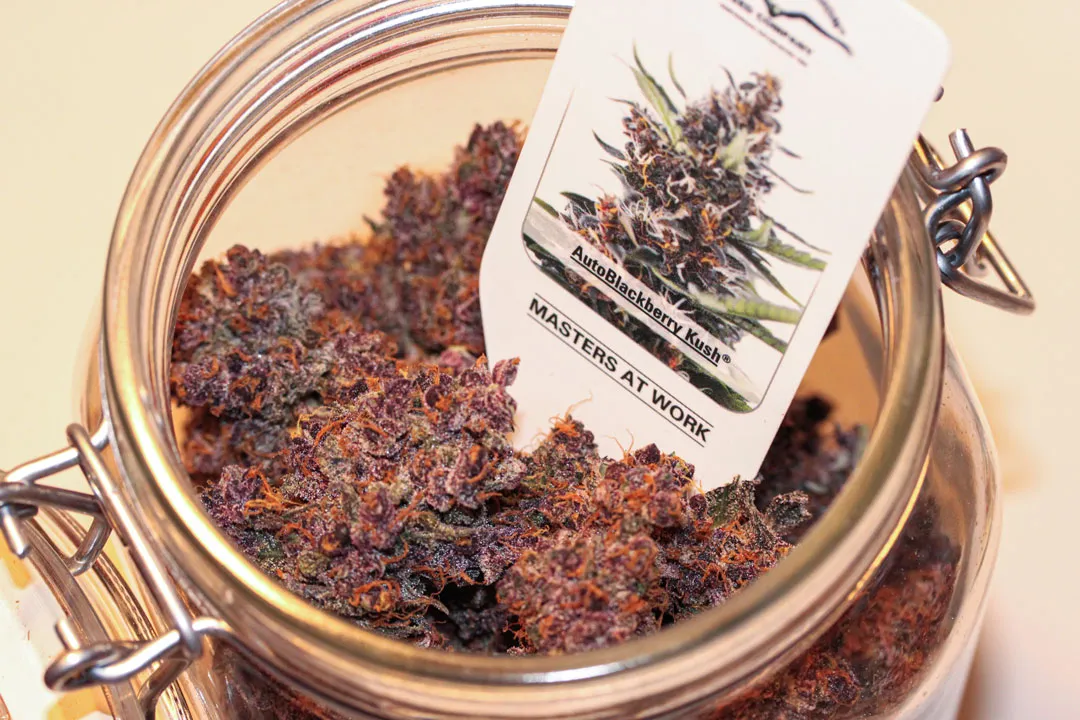
This is the tropical companion to harvesting and curing cannabis, which covers the process in general. Here we are only concerned with what has to change when the ambient air is working against you.
Why 18–20 °C and 55–60% actually matter
The numbers are not arbitrary tradition. Three separate processes are running while a flower dries, and they run at different speeds.
Water leaves. A freshly cut flower is roughly 75–80% water by weight. You are aiming to remove most of it, to a final moisture content around 10–12%. Kilogram of wet flower in, roughly 200–250 g of dry flower out.
Chlorophyll breaks down. This is what removes the grassy, hay-like taste of fresh cannabis, and it is enzymatic — it takes time, not heat. Rush the water out in three days and the chlorophyll is still there, locked into a flower that is now too dry for anything further to happen. That is the entire explanation for why flash-dried cannabis tastes green and scratches the throat, and it cannot be fixed afterwards.
Terpenes evaporate. The monoterpenes that carry most of the aroma — myrcene, limonene, pinene — are volatile at room temperature and their loss accelerates sharply with heat. Every degree above 20 °C costs you aroma. This is the reason the target is a cool room rather than merely a dry one, and it is the reason a dehydrator, an oven or a sunny balcony is never the answer.
So the target is a compromise: dry enough to stay ahead of mould, slow enough for the chlorophyll, cool enough for the terpenes. Ten to fourteen days at 18–20 °C and 55–60% RH is where those three meet.
What Thai air does to that
| Temperature | Relative humidity | Result | |
|---|---|---|---|
| Target | 18–20 °C | 55–60% | 10–14 days, good flavour |
| Bangkok ambient, wet season | 28–32 °C | 75–85% | Visible mould within 48 hours |
| Bangkok ambient, cool season | 24–28 °C | 60–70% | Marginal; too warm, too slow |
| Room with AC at 25 °C | 25 °C | 45–55% | Dry in 3–4 days; harsh and flat |
| AC + dehumidifier, sealed | 18–20 °C | 55–60% | What you are building |
Two things follow immediately. First, there is no month of the year in which Thai ambient air will dry cannabis properly, so this is equipment, not timing. Second — and this is the mistake most people make — an air conditioner on its own overshoots. It cools by condensing moisture out of the air, so a room cold enough to hit 18 °C is usually far drier than 55%, and you get the flash-dry failure rather than the mould failure. You need both machines, doing different jobs, with the dehumidifier on a humidistat and the AC on a thermostat.
Building the room
You do not need a large space. A wardrobe, a small bathroom without a window, or a grow tent standing inside an air-conditioned bedroom will all work. Small is easier — less air to condition and less infiltration.
What goes in it:
- An air conditioner holding 18–20 °C. An inverter split unit is far cheaper to run than a portable one, and portables vent hot air through a hose that also pulls unconditioned outside air into the room, which partly defeats the purpose.
- A dehumidifier with a humidistat, set to 58%. This is the controlling instrument. Without it the AC decides your humidity for you.
- A small fan on low, pointed at a wall. Air must move around the room so that no pocket sits still, but it must never blow directly onto the flowers — that dries their surface while the inside stays wet, which is both the flash-dry problem and a rot problem at once.
- A thermometer–hygrometer, ideally two, at canopy height rather than up near the ceiling. A cheap logging one that records overnight is worth buying, because the hours you are asleep are the hours things drift.
- Darkness. Light degrades THC and terpenes. The room stays dark except when you are working in it.
- A door that seals. Every gap is monsoon air coming in.
Something worth understanding about the physics: a refrigerant dehumidifier dumps its heat into the room, typically a few hundred watts of it, so it fights the air conditioner. In a small sealed drying room that is manageable, and the two will find an equilibrium. In a big leaky room it is a losing battle, which is another argument for keeping the space small.
Sizing the dehumidifier
Start from the water. Every kilogram of wet flower releases roughly 750 g of water over the drying period — call it 75 g a day. Ten kilograms of wet material is therefore about 750 ml a day of water, which sounds trivial, and on its own it would be.
What actually sizes the machine is the room. Pulling a sealed Thai room down from 80% to 58% in the first place, and then holding it there against whatever leaks in through the door seals, is most of the work. For a small domestic drying room a 10–20 litre/day unit is the normal answer.
Two adjustments before you buy:
- Rated capacity is quoted at a test condition, usually something like 30 °C and 80% RH. At 18 °C and 58% — precisely the condition you are trying to hold — the same machine delivers far less. Assume roughly half the headline figure unless the manufacturer publishes a low-humidity curve.
- Desiccant dehumidifiers hold up better at low temperatures than refrigerant ones, which is relevant here because 18 °C is at the low end of where refrigerant units are efficient. They also put out more heat.
Empty the tank daily, or plumb it to a drain. A full tank silently stops the machine and you will find out from the smell.
Trimming: wet or dry, in the tropics
In dry climates the classic advice is to dry-trim — hang the whole plant with its leaves on, so that it dries slowly and evenly, and manicure afterwards. That advice is calibrated for a climate where drying too fast is the risk.
In Thailand, invert it. Sugar leaves and fan leaves hold water against the flower, and wet vegetation packed around a bud in humid air is where Botrytis starts. The practical compromise most Thai growers arrive at:
- Remove all fan leaves and the large protruding sugar leaves at harvest, while wet. This cuts the moisture load substantially and opens the flower to air.
- Leave the small sugar leaves tucked into the bud, which give a little protection against over-drying.
- Do the final manicure after drying, when the trim comes off cleanly and the trichomes are less likely to be smeared.
Cut into manageable branches rather than hanging whole plants. A dense whole plant has an interior your room’s air never reaches.
The two weeks, in practice
Days 1–3. The fastest water loss. This is when the dehumidifier works hardest and when humidity in the room will try to climb every time you close the door. Check twice a day. The buds will feel cold and damp.
Days 4–8. The outside of the flower firms up. Resist the urge to speed anything up; the water is now coming from inside the bud and it is moving at the rate diffusion allows. Small stems begin to feel dry.
Days 9–14. Approaching done. Start testing daily.
The snap test: take a pencil-thick stem and bend it. If it bends, there is water in there. If it snaps cleanly with an audible crack, the bud is close.
The better test, because the snap test is a rough guide: put a handful of buds in a sealed jar with a small hygrometer and leave it for twelve hours. The reading equilibrates with the moisture inside the flower. If it settles at 60–65%, you are ready to cure. Above 70% they need more time on the line. Below 55% you dried too far, and while a humidity pack will bring the number back up, the terpenes are already gone.
Curing
Curing is where a competent dry becomes good cannabis. It is slow, it is boring, and it is the difference most people can taste.
- Into airtight glass jars, filled to about three quarters. Plastic bags and cling film are not substitutes; they hold odours and they do not seal reliably.
- Hold the jars at 60–62% RH. Two-way humidity packs make this easy and are widely available; they are for maintenance, and cannot rescue flower that went in wet.
- Burp daily for the first week — open each jar for ten to fifteen minutes to exchange the air, and check the smell. Ammonia means anaerobic breakdown and the flower needs to come out and dry further, immediately.
- After the first week, burp every few days for a fortnight.
- Two weeks is a minimum, four to eight weeks is where the improvement is. The aroma keeps developing for months.
- Keep jars cool and dark. A cupboard in an air-conditioned room, not a shelf in the sun. Heat undoes curing in exactly the way heat undoes drying.
If you find mould
Take the affected material out of the room entirely before you handle anything else — a mouldy bud sheds spores across everything hanging near it. Do not attempt to salvage it, and do not put it into a jar with clean flower “to see how it goes”. If mould appears at more than one point on the line, the room is wrong, not the plant: check the hygrometer at canopy height, check that the fan is actually moving air across the whole space, and check the door seals.
Flower that got wet in the field before it was cut is a separate problem, dealt with in preventing mould and bud rot in tropical Thailand.
If you are drying commercially
Two numbers matter beyond the ones above. The industry measure of microbial safety is water activity, not relative humidity — the accepted target is at or below 0.65 aw, which corresponds roughly to the 60–62% jar equilibrium described here. A water activity meter is expensive and is the correct instrument for a licensed operation.
And every batch needs a record: harvest date, drying room conditions, the dates it entered and left the dry room, moisture at packing, and the lot it belongs to. That chain is part of what GACP certification is testing, and the seed-to-harvest side of the same file is covered in GACP documentation for licensed cannabis farms in Thailand.
Genetics make the fortnight easier
Loose, airy flowers dry evenly; dense flowers hold water in a core your room’s air never reaches. If you are growing specifically to dry in a Thai wet season, the structural argument favours the same varieties that survive the field:
- Durban Poison — high calyx-to-leaf ratio, so there is less vegetation to trim and less water to remove.
- Siam’s Smile — tropical landrace flower structure, open enough to dry through.
- Skywalker Haze and Amsterdam Amnesia — elongated, airy sativa colas.
- Dense USA-genetics hybrids such as Sugar Bomb Punch and Meringue are magnificent, and they need a properly controlled drying room rather than a hopeful one.
The short version
Build a small sealed room. Put an air conditioner on 18–20 °C and a dehumidifier on 58%, and trust the hygrometer rather than the weather. Wet-trim the big leaves off at harvest, hang branches rather than whole plants, move air around the room but never at the flowers, and give it ten to fourteen days. Test with a jar and a hygrometer, not a guess. Then cure for a month.
The equipment costs a fraction of a season’s inputs, and it decides whether four months of work tastes like anything.