


Transitioning from Retail Dispensary to Medical Cannabis Clinic in Thailand
At the 2024 peak Thailand had something in the order of 18,400 licensed dispensaries. By early 2026 industry reporting put closures since that peak at around 7,300. The businesses that survived the June 2025 controlled-herb notification did not survive by waiting it out. They changed what they were.
The change is not cosmetic and it is not primarily a licensing exercise, although there is licensing in it. It is a shift from a retail business whose economics rest on footfall and basket size to a clinical one whose economics rest on a returning patient list. Almost everything else follows from that.
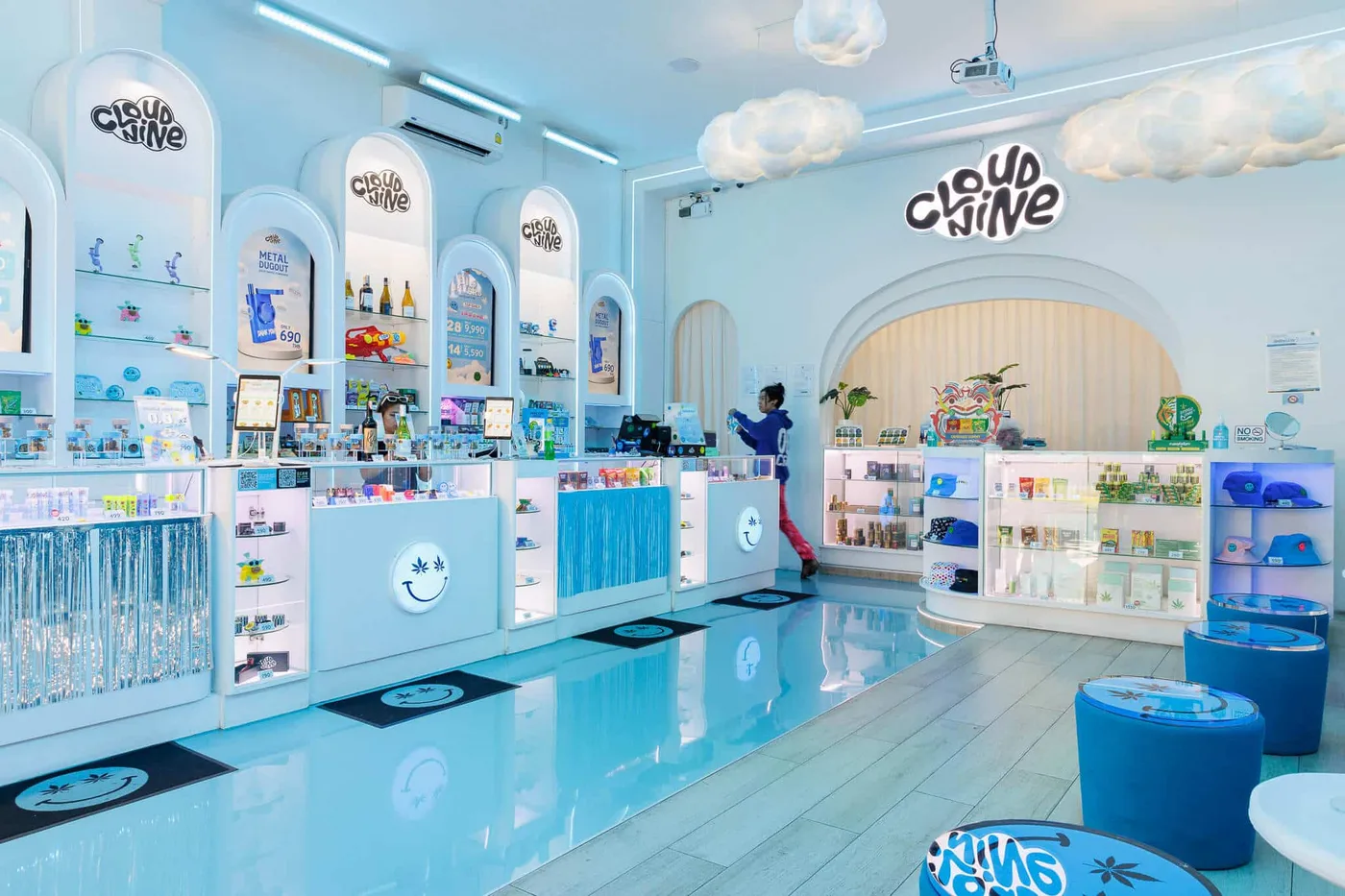
The retail floor at Cloud Nine Asoke, Bangkok — one of the dispensaries that stocks Dutch Passion seeds. Photo courtesy of Cloud Nine Thailand.
What actually changed, in one paragraph
Since 26 June 2025, cannabis inflorescence has been dispensable only against a prescription written by an authorised practitioner — a physician, dentist, pharmacist or Thai traditional medicine practitioner — issued on the official PT 33 form following a consultation, with the dispensing premises operating under practitioner supervision. Flower sold must originate from a GACP-certified cultivation site. Ministerial Regulation No. 2 B.E. 2569, in force from 30 April 2026, added cumulative conditions on licensed sellers, including trained staff present throughout opening hours. The full dated timeline is in Thailand cannabis regulation update.
The consequence for an operator is that the consultation is now the product, and the flower is what the consultation results in.
Three honest options
Before the operational detail, the strategic choice. There are three defensible positions and one that is not.
1. Compliant dispensing outlet under practitioner supervision. You keep the retail premises, engage the practitioner your licence requires, dispense against prescriptions, and tighten your sourcing and records. The lowest-cost route, and the one most survivors took first.
2. A genuine clinic. A licensed health facility with consultation rooms, patient records, follow-up, and cannabis as one therapy among the practitioner’s tools. Higher capital and regulatory burden, materially better retention, and a defensible position if rules tighten again.
3. Supply the sector instead of the public. Cultivation under GACP, or wholesale and services to clinics. Different licences, different capital, no patient-facing burden.
Not an option: continuing to sell flower over the counter to walk-in customers on the strength of a form filled in at the till. That is the business model the notification was written to end, and it is the fastest way to lose a licence.
The practitioner is a structural decision, not a hire
Which category of practitioner you engage determines what your business can actually do, because each prescribes within their own professional scope.
| Practitioner | Prescribing scope | Practical fit |
|---|---|---|
| Physician (แพทย์) | Widest; can diagnose and manage the underlying condition | A clinic model with genuine medical follow-up |
| Thai traditional medicine practitioner (แพทย์แผนไทย) | Within TTM practice, which is where the controlled-herb framework historically sits | The most common route for a converting dispensary |
| Pharmacist (เภสัชกร) | Dispensing and medicines expertise | Strong on formulary, dosing and interactions |
| Dentist | Narrow, within dental practice | Rarely the basis of a business |
Two things to settle before you sign anything. Coverage: the requirement is presence during operating hours, so one practitioner and six-day trading is an arithmetic problem, not a staffing preference — you will need a rota, and probably more than one practitioner. Independence: a practitioner’s clinical judgement cannot be a sales function. If your model needs prescriptions issued at a certain rate to work, the model does not work.
Whether your premises need a health-facility licence in addition to your controlled-herb sale licence depends on how far toward option 2 you go, and health-facility licensing is administered separately from the controlled-herb notification. Establish that with your provincial public health office before you sign a lease or start building consultation rooms, not after.
What the premises have to become
- A private consultation space. Not a corner of the shop floor. A patient discussing a medical condition needs a door.
- Separated dispensing. Working stock in a controlled, secured area; the retail floor becomes reception and education rather than self-service.
- Records infrastructure. Patient files, prescription records, dispensing records against prescriptions, and stock records that reconcile to them. Whether that is paper or software, it needs to be retrievable on request and backed up.
- Storage that protects the product. Cool, dark, humidity-controlled bulk storage rather than display jars in the sun.
- A training log. Who was trained, on what, by whom, when — plus a rota showing that trained staff covered every trading hour.
The formulary: fewer products, documented
This is where a converting dispensary most often gets the strategy wrong, and it is the one place where a seed supplier has something useful to say.
A retail shop competes on range: forty jars, evocative names, whatever the wholesaler had that week. A clinic cannot work that way, because a practitioner prescribing for a patient’s insomnia in March needs the same thing to exist in June. Prescribing requires consistency, and consistency requires named cultivars from documented genetics, sourced from a farm that can reproduce them.
Practically, that means moving to a formulary: a deliberately short list of cultivars, each chosen for a defined chemotype, each with a documented lineage, each with a supply relationship behind it.
| Formulary slot | What it is for | Example genetics |
|---|---|---|
| CBD-dominant, low THC | Patients who need therapeutic effect without intoxication | CBD Charlotte’s Angel, CBD Auto Charlotte’s Angel |
| Balanced / CBD-rich indica-type | Evening use, physical complaints | CBD Auto Blackberry Kush |
| THC-dominant sativa-type | Daytime use where alertness matters | Durban Poison, Power Plant |
| THC-dominant indica-type | Evening use, rest | Sugar Bomb Punch, Banana Blaze |
| Regional / heritage | Patients and practitioners who value Thai lineage | Siam’s Smile |
Note that a formulary is defined by chemotype, not by strain names on a chalkboard. The name is only useful because it points at a documented genetic source. Two lots called “Amnesia” from two informal suppliers are two different products; two lots grown from the same documented seed line by a GACP-certified farm are a repeatable one. Background on CBD-dominant chemotypes specifically is in high-CBD strains in Thailand.
The commercial argument for a short documented formulary is simply that it is the only range you can honestly stand behind, and standing behind it is what a patient is paying the consultation fee for.
Sourcing, and why it is now a contract rather than a purchase
Under the retail model you bought what was available. Under the clinical model you need the same cultivar, at a comparable profile, on a predictable schedule. That is a contract cultivation relationship with a named GACP-certified farm growing named cultivars, not a rolling series of spot purchases.
Get the sourcing file right at the outset — supplier licences and GACP certificates with their scope and expiry, lot identifiers that link back to propagation material, certificates of analysis, and input records. The full intake checklist and a supplier questionnaire you can send as it stands are in how the controlled herbs framework affects dispensary inventory and sourcing.
If you are contracting a farm, its GACP file has to start at the seed, and yours depends on theirs — GACP documentation for licensed cannabis farms in Thailand sets out what the auditor is testing.
The economics are genuinely different
Worth modelling honestly before committing capital, because the shape of the revenue changes completely.
Retail dispensary: high walk-in volume, low repeat rate, revenue proportional to footfall, heavily exposed to tourist seasonality and to street location. Rent is the dominant fixed cost and it is priced on footfall you may no longer need.
Clinic: lower volume, far higher repeat rate, revenue proportional to the active patient list. A patient with a chronic indication who returns on a defined supply cycle is worth many multiples of a walk-in sale, and they are not seasonal.
Consequences most operators underestimate:
- A prime tourist-street lease may now be a liability. You are paying for footfall that cannot lawfully buy without a consultation. A cheaper, quieter location with parking and privacy may serve the new model better — this is often the single largest cost lever available.
- Practitioner cost is a fixed cost tied to opening hours, so long opening hours are expensive in a way they were not before. Appointment-led opening beats all-day trading.
- Patient acquisition replaces passing trade, and it works through referral, practitioner networks and genuine education rather than signage.
- Follow-up is revenue, not admin. A scheduled review is both good practice and the mechanism by which the patient list persists.
Advertising: assume it is restricted
Both the promotion of a controlled herb and the advertising of a health facility are regulated in Thailand, and the safe operating assumption is that anything resembling a therapeutic claim, a price promotion on flower, or advertising aimed at the general public is a problem. Educational content, factual descriptions of your services, and information for referring practitioners are the defensible ground. Take specific advice before any campaign; the penalties in this area are not proportionate to the marketing benefit.
Anyone with non-Thai ownership should also take advice on the Foreign Business Act position early. The April 2026 ministerial regulation on high-THC extracts restricts licensing to Thai juristic persons that are not “foreign” under that Act, along with government agencies and the Thai Red Cross Society — a reminder that nationality of ownership is load-bearing in this sector, and that health-facility ownership and professional practice carry their own nationality and licensure constraints.
A phased plan
Phase 1 — stabilise (weeks 1–4). Confirm your current licence conditions with your licensing officer. Engage the practitioner and fix the rota. Stop dispensing anything you cannot trace to a GACP-certified site. Start the training log today; it is the cheapest record to keep prospectively and the most annoying to reconstruct.
Phase 2 — rebuild the range (weeks 4–12). Cut the SKU count. Define the formulary by chemotype. Qualify two or three suppliers properly and open contract discussions on your core cultivars. Rebuild storage.
Phase 3 — rebuild the premises and the process (months 3–6). Consultation space, records system, appointment booking, follow-up protocol. Decide whether you are going as far as a licensed health facility, and if so start that conversation with the provincial public health office.
Phase 4 — rebuild the revenue (months 6–12). Grow the patient list through referral and education. Review the lease against the model you now have. Measure the active patient list rather than daily takings.
What we can help with
We are a seed supplier, so our part of this is narrow and specific: documented genetics for the cultivars in your formulary, and the provenance documentation your contract farm needs at the start of its GACP file. We prepare that against your stated requirement rather than issuing a standard pack, and it is far easier to assemble at the point of order than to reconstruct later. Contact us with your licence details and what your auditor asks for.
A note on what this article is
This is a practical account of how Thai cannabis retailers are adapting, written by a seed supplier that works with licensed businesses. It is not legal, medical or financial advice. Licensing for controlled-herb sale, health-facility operation, and professional practice are administered by different bodies with different requirements, and those requirements have changed repeatedly since 2022. Confirm your own position with your licensing officer and your own counsel before committing capital. The law page on this site is the one we re-date when the rules move.