


The Rise of Cannabis in Thailand: 2018 to Today
Thailand legalised medical cannabis before any of its neighbours, removed the plant from its narcotics list entirely four years later, ran the most open cannabis retail market in Asia for three years, and then made the flower prescription-only again. That whole arc took seven years. This is what happened, in order, and what it means for anyone growing here now.
If you only need the current rules, read Thailand Cannabis Regulation Update instead — it is maintained as the statement of what applies today. This page is the history that explains how the rules got their present shape.
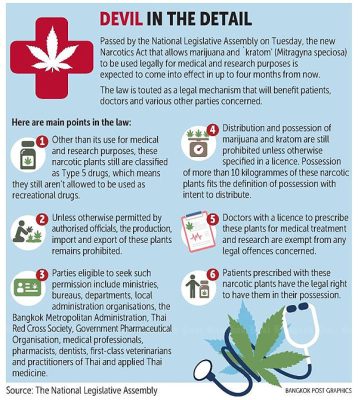
The graphic above is from 2018, and it is worth reading as a period piece. Point one states that cannabis and kratom remain Category 5 narcotics, usable only for medical and research purposes. That was accurate when it was printed and stopped being accurate in June 2022. Almost every explainer written about Thai cannabis has aged the same way, which is the single best reason to check the date on anything you read about it — including this page.
2018: the first medical law in Southeast Asia
At the end of 2018 Thailand’s National Legislative Assembly amended the Narcotics Act to permit cannabis for medical treatment and research. It was the first law of its kind in Southeast Asia, and it was narrow: the plant stayed a Category 5 narcotic, and the people allowed to work with it were a defined list — government agencies, universities, medical professionals, the Thai Red Cross, and practitioners of traditional Thai medicine.
Nothing about it created a consumer market. What it created was a legal channel for research and for licensed medical supply, and a precedent that the plant could be regulated rather than simply prohibited.
June 2022: the plant leaves the narcotics list
The decisive change came on 9 June 2022, when a Ministry of Public Health notification removed every part of the cannabis and hemp plant from Category 5 — with one carve-out that has been misunderstood ever since. Extracts containing more than 0.2% THC by weight were never delisted. The plant was decriminalised; concentrated THC was not, and still is not.
From the same date, cultivation became a notifiable activity rather than a licensed one, registered through the Thai FDA’s system — the one most people know by the name of its app, Plook Ganja. Registering to grow was, and remains, a form rather than a permission.
A week later, on 16 June 2022, a second notification designated cannabis a controlled herb under the Protection and Promotion of Traditional Thai Medicine Wisdom Act B.E. 2542. This is where the rules most people can recite actually came from: no sale to anyone under 20, none to pregnant or breastfeeding women, and public smoking treated as a nuisance under the Public Health Act, carrying up to three months’ imprisonment and a fine of up to 25,000 baht.
Those rules were in force throughout the period everyone remembers as “legal weed in Thailand”. They were widely ignored.
2022 to 2025: the years without a law
A comprehensive Cannabis and Hemp Act was drafted, debated, and repeatedly not passed. In its absence an entire retail sector grew up under ministerial notifications written for herbal medicine, not for shops. Dispensary numbers reached roughly 18,400 by 2024.
That is the part worth understanding about the “boom”: it was never built on a cannabis law. It was built on the absence of one, inside a framework that had been designed for something else, which is why it could be narrowed by notification as quickly as it had opened.
June 2025: flower becomes prescription-only
On 26 June 2025 the Notification on Controlled Herbs (Cannabis) B.E. 2568 closed the open-retail period. Cannabis inflorescence — the flower — may now be dispensed only against a prescription written by an authorised practitioner, on the official PT 33 form, following a consultation. Dispensaries selling flower must operate under a licensed practitioner’s supervision, and flower that is sold or exported must come from a cultivation site certified under GACP, the Good Agricultural and Collection Practices standard administered by the Department of Thai Traditional and Alternative Medicine.
The effect was fast. By February 2026, industry reporting put the number of dispensaries that had closed since the 2024 peak at around 7,300. Two ministerial regulations in April 2026 tightened the licensing around extracts and around flower retail further still.
What the seven years left behind
Three things survived all of it, and they are the reasons Thailand remains a serious place to grow.
The climate is still the climate
A long season, high light levels year-round and the option of two outdoor cycles are not affected by any notification. What the tropics demand in return is specific: humidity management through the monsoon, genetics that finish before the rain settles in, and heat tolerance from March to May. Those are cultivation problems, and they are covered in preventing mould and bud rot and in high-THC strains for outdoor growing in Thailand.
The genetics are still here
Thailand’s landrace sativas — the lineage behind what the world knew as Thai stick — are a real horticultural inheritance, and the reason Thai sativa turns up in so many modern hybrids. Preserving and working with that material is slower and less glamorous than a retail boom, and it outlasts one. It is why Siam’s Smile exists as a Thai-bred variety rather than an import.
Seeds were never the controlled item
Through every stage above — the 2018 medical law, the 2022 delisting, the 2025 return to prescriptions — the regulated articles have been the flower and the high-THC extract. Seeds have not been the subject of the restrictions, and home cultivation remains a notifiable activity rather than a prohibited one.
What to do with this
If you are growing at home, the requirement is registration, and the constraints on you are agronomic rather than legal. If you intend to sell flower, the relevant standard is GACP certification and a practitioner-supervised outlet, and the current detail is in the regulation update. If you are choosing what to grow, start from the climate rather than the market: see the outdoor seeds and fast-flowering varieties that were bred for exactly this problem.
And confirm anything legally consequential with the Thai FDA or the Department of Thai Traditional and Alternative Medicine directly. This page is written by a seed company, it is dated, and Thai cannabis policy has changed four times in seven years.